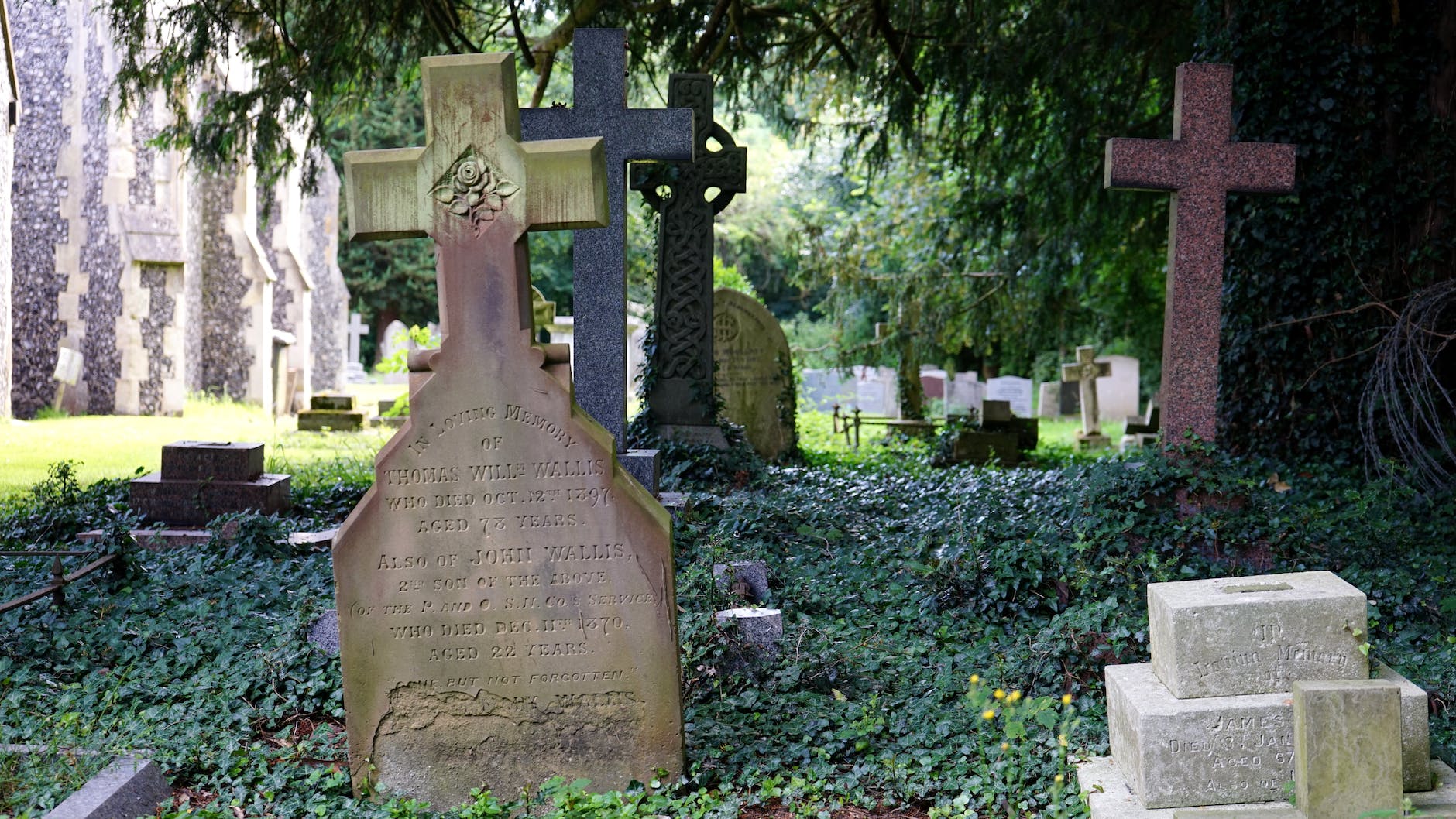
comma, not a period

20230903

Photo by Erik Karits on Pexels.com

comma, not a period

Hebrews 11:20-22 (JDV)

Hebrews 11:20 By faith Isaac blessed Jacob and Esau concerning things to come.
Hebrews 11:21 By faith Jacob, when he was dying, blessed each of the sons of Joseph, and he worshiped, leaning on the top of his staff.
Hebrews 11:22 By faith Joseph, as he was nearing the end of his life, mentioned the exodus of the Israelites and gave instructions concerning his bones.

comma, not a period

These three men—Isaac, Jacob, and Joseph—stand in Hebrews 11 as examples of a faith that looks beyond the moment of death without denying the reality of death. They did not pretend death was an illusion. They did not comfort themselves with the idea that death is a doorway into a conscious heavenly existence. Their confidence was not rooted in escaping death but in what God would do after death.

They faced death with clarity, not denial. They blessed their descendants, spoke of the future, and gave instructions about what would happen long after they were gone. Why? Because they believed that God’s promises extended beyond their lifetimes. They believed that death was not the end of God’s story for them. They believed that the God who had spoken would still be God on the other side of their graves.

Death, for them, was a comma—not a period.

They could see the future because God had revealed it. They could remain confident because God would be there. Their faith was not in their own endurance but in God’s faithfulness. They died, but they died looking forward. They died trusting that the same God who had guided their steps would one day raise them from the dust and fulfill every promise He had made.

This is the kind of faith Hebrews celebrates—not a denial of death, but a defiance of death’s finality. A faith that sees beyond the grave because it sees the God who stands beyond the grave.

Posted in future, sleep of death | Tagged | 1 Comment

resolve to be ridiculous

20230902

Photo by Princess Mijares on Pexels.com

resolve to be ridiculous

Hebrews 11:17-19 (JDV)

Hebrews 11:17 By faith Abraham, when he was tested, offered up Isaac. He received the promises and yet he was offering his one and only son,
Hebrews 11:18 the one to whom it had been said, Your offspring will be called through Isaac.
Hebrews 11:19 He considered God to be able even to raise someone from the dead; therefore, he received him back, figuratively speaking.

resolve to be ridiculous

Abraham’s test looked absurd from every human angle. God asked him to do something that violated instinct, emotion, logic, and even the promise God Himself had made. Nothing about the command made sense—except the character of the One who gave it. That was the hinge. Abraham obeyed not because the command was reasonable, but because the Commander was trustworthy. Faith often looks like that: stepping forward when the path looks impossible, because the God who calls is faithful.

Your observation captures the heart of Hebrews 11. Faith is not a heroic confidence in our own ability. It is the settled conviction that God can be trusted even when His instructions stretch us beyond what seems sensible. Abraham’s test was not about Isaac. It was about whether Abraham believed that God could solve a problem Abraham could not even imagine solving. And Abraham concluded that God could—even if it meant raising the dead.

That is where every test of faith eventually leads: to the end of our ability and the beginning of God’s. When we reach the point where we say, “This makes no sense,” God is often saying, “Now you’re ready to trust Me.” When we reach the point where we say, “I can’t fix this,” God is saying, “Good—now watch what I can do.” Faith is not reckless; it is responsive. It listens for the Father’s voice and obeys, even when obedience feels unreasonable.

You’re right: you cannot create a problem God cannot solve. You cannot walk into a situation where His wisdom is insufficient. You cannot face a test where His power is inadequate. The tests that feel ridiculous to us are often the very places where God intends to reveal His glory.

Abraham’s story is not meant to intimidate us but to invite us. The God who carried him through the impossible is the same God who walks with you today.

Posted in faith, trust | Tagged | Leave a comment

the better place

20230901

Photo by Quang Nguyen Vinh on Pexels.com

the better place

Hebrews 11:13-16 (JDV)

Hebrews 11:13 These all died in faith, although they had not received the promised things. But they saw them from a distance, greeted them, and confessed that they were foreigners and temporary residents on the land.
Hebrews 11:14 Now those who say such things make it clear that they are seeking a homeland.
Hebrews 11:15 If they were thinking about where they came from, they would have had an opportunity to return.
Hebrews 11:16 But they now desire a better place – one from the sky. Therefore, God is not ashamed to be called their God, for he has prepared a city for them.

the better place

The writer of Hebrews is remarkably consistent: the “better place” is not heaven as a disembodied realm, nor is it the destination of believers at death. It is the future world God has promised—a world that will be revealed when Christ appears. The hope of the faithful is not escape from the earth but the arrival of God’s kingdom to the earth.

Abraham understood this. He walked the land of promise as a foreigner, not because the land was unimportant, but because its fulfillment lay in the future. He looked for a city “whose architect and builder is God,” a city that comes down from heaven, not one we ascend to. Daniel saw the Son of Man coming with the clouds of the sky, bringing dominion with him. John saw the holy city descending from the sky, establishing God’s dwelling with humanity. Both visions point forward to the same moment—the appearing of Christ.

None of these visions describe what happens at death. They describe what happens at the return of the King.

That is why Paul calls it “the blessed hope—the glorious appearing of our great God and Savior, Jesus Christ” (Titus 2:13). The hope is not death. The hope is not heaven. The hope is the appearing. That is when the better place arrives. That is when the promises are fulfilled. That is when the inheritance becomes visible. That is when the world is made new.

We walk today in the land our Savior has promised to renew. We wait for the city Abraham longed for. We look for the King Daniel saw. We anticipate the descent John witnessed. And when he appears, the better place will appear with him.

Posted in kingdom of God, second coming | Tagged | 1 Comment

beyond our personal limits

20230831

Photo by Anna Shvets on Pexels.com

beyond our personal limits

Hebrews 11:11-12 (JDV)

Hebrews 11:11 By faith even Sarah herself, when she was unable to have children, received power to conceive offspring, even though she was past the age since she considered that the one who had promised was faithful.
Hebrews 11:12 Therefore, from one man – in fact, from one as good as dead – came offspring as numerous as the stars of the sky and as innumerable as the grains of sand along the seashore.

beyond our personal limits

Sarah’s story is one of Scripture’s clearest reminders that God delights in beginning where human ability ends. The text does not soften her condition. It emphasizes it. She was unable to conceive. Not “unlikely,” not “delayed,” not “struggling”—unable. And even if she had once been able, that season had long passed. She was “past the age.” The window was closed. The opportunity was gone. Humanly speaking, the story was over.

But that is precisely where God writes His best chapters.

Sarah’s womb was not merely weak; it was dead. And God chose that very place to display His power. He waited until every natural possibility had expired so that the child of promise would be unmistakably the work of God. Isaac was not the product of human strength but of divine intervention. Sarah’s faith did not lie in her capacity but in God’s character. She judged Him faithful who had promised.

This is the pattern Paul describes in Ephesians 2. Salvation itself begins where our workmanship ends. We bring nothing but need. We contribute nothing but inability. And God meets us there—not with demands, but with grace. “By grace you are saved through faith… it is the gift of God.” Then, once the limits of our workmanship are exposed, God adds His workmanship. We become His creation, shaped for good works He prepared long before we ever imagined them.

God starts where we stop.

He begins where we break.

He works where we cannot.

When we finally reach the point where we say, “I can’t,” heaven answers, “Now we can begin.” That is the soil in which faith grows. That is the moment when God’s power becomes visible. Sarah’s story is not an exception—it is a pattern. God delights in using the places of our inability as the stage for His glory.

Wherever your limits lie today, that is where faith begins. That is where God is ready to work.

Posted in faith, miracles, trust | Tagged | Leave a comment

a foreigner in the land of promise

20230830

OSIRIS-REx Views the Earth During Flyby by NASA Goddard Photo and Video is licensed under CC-BY 2.0

a foreigner in the land of promise

Hebrews 11:8-10 (JDV)

Hebrews 11:8 By faith Abraham, when he was called, obeyed and set out for a place that he was going to receive as an inheritance. He went out, even though he did not know where he was going.
Hebrews 11:9 By faith he stayed as a foreigner in the land of promise, living in tents as did Isaac and Jacob, coheirs of the same promise.
Hebrews 11:10 You see, he was looking forward to the city that has foundations, whose architect and builder is God.

a foreigner in the land of promise

Abraham’s life is a quiet rebuke to the shallow, other‑worldly version of hope that many Christians have inherited. He walked the very soil God promised him, yet he walked it as a foreigner. He lived in tents on land that would one day be his, but not yet. His inheritance was real, physical, earthly—but deferred. And the city he longed for was not an escape to heaven but the arrival of heaven’s city to earth. Hebrews says he looked for a city “whose architect and builder is God,” and Revelation shows that very city descending from heaven into the renewed earth.

So Abraham’s hope was from heaven, but it was not heaven itself. His hope was the appearing of the One who would bring the kingdom with him. That is the blessed hope—the glorious appearing of our great God and Savior. Abraham walked by faith in a land that would one day be transformed by that appearing.

And so do we.

We walk today in the land our Savior has promised to renew. We live as foreigners in the very world that will one day be our eternal home. We wait for the same city Abraham waited for. We look for the same appearing. We trust the same God who keeps promises across centuries.

Abraham’s footsteps remind us that our hope is not escape but fulfillment. Not abandonment of the earth but its restoration. Not drifting upward to heaven but heaven coming down in glory.

We walk now in the land of promise, waiting for the King who will make all things new.

Posted in renewal, second coming | Tagged | Leave a comment

do what you can

20230829

Photo by Nuno Obey on Pexels.com

do what you can

Hebrews 11:7 (JDV)

Hebrews 11:7 By faith Noah, after he was warned about what was not yet seen and motivated by godly fear, built an ark to deliver his family. By faith he condemned the universe and became an heir of the righteousness that comes by faith.

do what you can

Noah’s story is a reminder that faithfulness is measured not by the size of our influence but by the sincerity of our obedience. He lived in a world spiraling out of control—a world violent, corrupt, and deaf to every warning. He preached righteousness, but no one listened. He built an ark, but no one joined him. He warned of judgment, but no one believed him. In the end, the only people who entered the ark were the ones under his own roof.

And yet Scripture calls him a hero of faith.

Why? Because he did what he could, not what he wished he could. He could not save the world, but he could save his family. He could not change the culture, but he could obey God. He could not control the response of others, but he could remain faithful in his own calling. Noah’s greatness lies not in the size of his results but in the steadiness of his obedience.

That is the pattern for us.

The world may feel chaotic. People may not listen. Your influence may seem small. But God does not ask you to do everything. He asks you to do what you can—what he has placed within your reach. A conversation. A prayer. A word of encouragement. A quiet act of faithfulness. A life lived with integrity. A family shaped by grace. These things matter more than we realize.

Noah’s faith changed the future of the world because he was faithful in the sphere God gave him. The same is true for you. You may not be able to save everyone, but you can be faithful with the people and responsibilities God has entrusted to you. That is where heroism begins.

Posted in commitment | Tagged | Leave a comment

faith to draw near

20230828

Photo by Designecologist on Pexels.com

faith to draw near

Hebrews 11:6 (JDV)

Hebrews 11:6 Now without faith, it is impossible to please God since the person who draws near to him must believe that he exists and that he rewards those who seek him.

faith to draw near

Faith requires drawing near to a God who cannot be seen. That is the tension at the heart of Hebrews. The world trains the senses to trust only what is visible, measurable, and immediate. But the life of faith begins by acknowledging that the deepest realities are not accessible to sight. God is invisible, yet he is not distant. He is unseen, yet he is not unreachable. To relate to him, faith must take hold of two convictions: that he exists, and that he desires relationship with those who seek him.

The first conviction—believing that God exists—is more than intellectual assent. It is the recognition that the visible world is not self‑contained. Creation points beyond itself. Conscience points beyond itself. History points beyond itself. Faith sees the fingerprints of the unseen God in the world that can be seen. It acknowledges that behind the order, beauty, and moral structure of life stands a personal Creator who is real, active, and sovereign.

The second conviction—that God rewards those who seek him—moves faith from mere belief to relationship. It affirms that God is not only real but relational. He is not indifferent, silent, or unmoved. He desires to be known. He invites those who seek him. He responds to those who draw near. Faith approaches God not as a distant force but as a Father who welcomes, listens, and gives grace. This is why Hebrews insists that drawing near requires believing both truths. One without the other is incomplete. To believe God exists but does not care leads to fear. To believe God cares but does not exist leads to fantasy. Faith holds both together.

This kind of faith is not blind. It does not ignore the visible world or pretend that God can be proven by sight. Instead, it recognizes that the unseen is just as real as the seen, and often more enduring. It trusts that God’s presence, though invisible, is certain. It believes that his promises, though not yet fulfilled, are reliable. It draws near because it knows that the God who cannot be seen is the God who has revealed himself in his word, in his works, and supremely in his Son.

Such faith is the beginning of every relationship with God. It is the posture that opens the heart to his presence and the life to his guidance. It is the confidence that the unseen God is both real and willing to be found.

Posted in faith | Tagged | Leave a comment

grace to Enoch

20230827

Photo by Mike B on Pexels.com

grace to Enoch

Hebrews 11:5 (JDV)

Hebrews 11:5 By faith Enoch was transferred, and so he did not see death. He was not to be found because God transferred him. You see, before he was transferred, he was approved as one who pleased God.

grace to Enoch

The brief account of Enoch in Hebrews is often surrounded by layers of tradition, imagination, and later myth, but the text itself is remarkably clear. Enoch “was taken,” meaning his life ended before the flood, but Hebrews interprets that event in a way that corrects the common assumption that he escaped death entirely. The same chapter that mentions Enoch also insists that all the heroes of faith died without receiving the promises (Hebrews 11:13). The writer does not carve out exceptions. The point is theological, not biographical: even the greatest examples of faith still awaited the fulfillment of God’s promises. Their hope was future, not present. Their reward was certain, but not yet realized.

In that sense, Enoch’s story becomes an illustration of grace rather than an escape from mortality. He was spared from witnessing the devastation that would fall on the world of his descendants. His life ended before the judgment of the flood arrived. His “being taken” was not an elevation to heavenly glory but a merciful removal from the unfolding corruption and sorrow of his generation. His faith pleased God, and God granted him rest before the storm.

This pattern reflects a broader truth about the way God deals with his people. Death, though an enemy, can also be a mercy. It draws a boundary around the suffering a person must endure. It prevents the faithful from witnessing the full consequences of the failures, rebellions, and tragedies that may unfold in later generations. Scripture often portrays death for the righteous as a gathering into peace, a release from the turmoil of the world, and a protection from future evil. Isaiah speaks of the righteous being taken away “to be spared from evil,” entering into peace while the world continues in turmoil.

In that sense, the grace shown to Enoch is not unique. Believers today experience the same mercy. Life is finite not only because of the fall but also because God, in compassion, limits the sorrow his people must witness. No one sees the full measure of the world’s decline. No one bears the entire weight of generational failure. Death becomes a doorway into rest, shielding the faithful from what lies ahead.

Enoch’s story, then, is not about escaping the human condition but about receiving God’s kindness within it. His life and death remind us that God knows how much each person can bear, and he lets his people die at the right time, sparing them from burdens they were never meant to carry.

Posted in grace, sleep of death | Tagged | Leave a comment

He had one shot

20230826

Photo by Mikhail Nilov on Pexels.com

He had one shot

Hebrews 11:4 (JDV)

Hebrews 11:4 By faith Abel offered to God a better sacrifice than Cain did. By faith, he was approved as a righteous man because God approved his gifts, and even though he is dead, he still speaks through his faith.

He had one shot

Abel’s story stands out in Hebrews because it is so brief, so early, and yet so decisive. He had only one moment recorded in Scripture in which his faith was expressed—a single offering, a single act of devotion, a single opportunity to honor God. That moment became his legacy. He did not waste it. He did not hedge, delay, or negotiate. He offered what was right, and his faith still speaks long after his life ended.

Most people are given far more time than Abel ever had. Years, decades, entire lifetimes unfold with countless opportunities to demonstrate trust, obedience, and devotion. Some of those opportunities are dramatic, but most are quiet and ordinary—choices made in private, sacrifices offered without applause, acts of faithfulness that no one else sees. Yet each moment carries weight. Each moment becomes part of the testimony a life leaves behind.

Abel’s example reminds us that the measure of a life of faith is not its length but its direction. A single act of genuine devotion can echo through generations. A lifetime of small, steady acts of faith can shape a legacy that honors God long after the person is gone. The point is not how much time is available but how that time is used. Whether the span is short or long, the call is the same: offer what is in hand to the God who sees, remembers, and rewards.

Whatever resources, years, gifts, or opportunities are present today, they can be placed before God in the same spirit Abel displayed. Faith does not wait for ideal conditions. It does not postpone obedience until circumstances feel perfect. It takes what is given—whether a single moment or a lifetime—and turns it into worship.

Abel had one shot, and he used it well. Many have far more. The invitation is to let every moment, however many remain, become an offering that reflects trust in the God who receives and honors the faith of his people.

Posted in faith, faithfulness | Tagged | Leave a comment

inhabitant or hero?

20230825

Photo by Jonathan Borba on Pexels.com

inhabitant or hero?

Hebrews 11:1-3 (JDV)

Hebrews 11:1 Now faith is the reality of what is hoped for, the proof of what is not seen.
Hebrews 11:2 You see, by it, our ancestors won God’s approval.
Hebrews 11:3 By faith we understand that the ages were created by the word of God, so that what is seen was made from things that are not visible.

inhabitant or hero?

The passage describes a kind of faith that stands in sharp contrast to the assumptions of the present age. Modern culture is comfortable with explanations that limit reality to what can be seen, measured, or verified. It treats the visible world as the whole world. Anything beyond the senses is dismissed as unnecessary or unscientific. Within such a framework, faith becomes either sentimental or irrelevant.

But the faith described in Hebrews is of a different order. It does not deny the visible world or pretend that suffering, loss, and hardship are illusions. It sees them clearly and takes them seriously. Yet it refuses to let the visible define the whole of reality. It insists that what is unseen—God’s promises, God’s presence, God’s future—is just as real, and ultimately more decisive, than what can be observed. This kind of faith looks at the same world everyone else sees, but interprets it through the lens of God’s word rather than the limits of human sight.

Such faith is not naïve optimism. It is the faith that sustained the heroes of Hebrews 11—men and women who endured suffering, exile, persecution, and death because they were convinced that the unseen promises of God were more substantial than the visible threats of the world. They lived in the same world as their contemporaries, but they lived differently because they trusted a reality that others refused to acknowledge. Their victories were not always visible victories. Many of them died without receiving what was promised. Yet Scripture calls them heroes because they saw beyond the present moment and anchored their lives in the eternal.

This kind of faith is rare because it requires courage. It demands the willingness to endure misunderstanding, to accept hardship, and to walk a path that cannot always be explained to those who see only what is in front of them. It is possible to live an entire life in this world without ever exercising such faith. Many do. But those who do so will never join the ranks of those whom Scripture calls heroes—those who lived by the unseen and overcame through trust in God.

The invitation of Hebrews is to embrace that deeper, unseen reality. It is the path of those who endure, those who overcome, and those whose lives bear witness to a kingdom not yet visible but absolutely certain.

Posted in faith | Tagged | Leave a comment