the farther, the deeper

20230213

Photo by Oliver Sju00f6stru00f6m on Pexels.com

the farther, the deeper

Ezekiel 47:3-6a (JDV)

Ezekiel 47:3 As the man went out east with a measuring line in his hand, he measured off a third of a mile and led me through the water. It came up to my ankles.
Ezekiel 47:4 Then he measured off a third of a mile and led me through the water. It came up to my knees. He measured off another third of a mile and led me through the water. It came up to my waist.
Ezekiel 47:5 Again he measured off a third of a mile, and it was a river that I could not cross on foot. For the water had risen; it was deep enough to swim in, a river that could not be crossed on foot.
Ezekiel 47:6 He asked me, “Do you see this, son of Adam?”

the farther, the deeper

As the water spread, it became deeper. That is how the Holy Spirit within us works. He changes us, but the transformation becomes even more miraculous when we move out into the world. The farther we go, the deeper the change. Welcome to the amazing world of witness.

Posted in Holy Spirit, witness | Tagged | Leave a comment

water from the temple

20230212

Photo by Rifqi Ramadhan on Pexels.com

water from the temple

Ezekiel 47:1-2 (JDV)

Ezekiel 47:1 Then he brought me back to the entrance of the house and I noticed water flowing from under the threshold of the house toward the east, for the house faced east. The water was coming down from under the south side of the threshold of the house, south of the altar.
Ezekiel 47:2 Next he brought me out by way of the north gate and led me around the outside to the outer gate that faced east; I noticed the water was trickling from the south side.

water from the temple

Water trickles out of the temple, but as it flows, it gets deeper. That water brings life and health to all it touches, salts the earth, and produces much fish, and abundant fruit. Every image of this vision is used by New Testament authors to describe the destiny that awaits the righteous. The fact that the water comes from the temple implies that all of these new earth realities flow from the presence of God. The sea represents the nations, the target of the flow. Jesus said that water will flow from the heart of believers (John 7:38). Life, abundance, and healing begin today. Its full realization will be at the coming of Christ.

LORD, may your life, love, and healing flow through us, to the nations.

Posted in sanctification, witness | Tagged | Leave a comment

four kitchens

20230211

Photo by Pixabay on Pexels.com

four kitchens

Ezekiel 46:21-24 (JDV)

Ezekiel 46:21 Next he brought me into the outer court and led me past its four corners. I noticed a separate court in each of its corners.
Ezekiel 46:22 In the four corners of the outer court there were enclosed courts, forty cubits long by thirty cubits wide. All four corner areas had the same dimensions.
Ezekiel 46:23 There was a stone wall around the inside of them, around the four of them, with ovens built at the base of the walls on all sides.
Ezekiel 46:24 He said to me: “These are the kitchens where those who minister at the house will cook the people’s sacrifices.”

four kitchens

Four corner kitchens in the outer court seem to hint at an expansion of the term “people” — to include those of all the nations. It fits the attitude our Savior reflected in his teachings, that the temple was to be a house of prayer for all nations, and that the gospel should be preached to all nations.

bbjv - 1

Posted in evangelism | Tagged | Leave a comment

eating to his glory

20230210

Photo by julie aagaard on Pexels.com

eating to his glory

Ezekiel 46:19-20 (JDV)

Ezekiel 46:19 Then he brought me through the entrance that was at the side of the gate, into the priests’ sacred chambers, which faced north. I noticed a place there at the far western end.
Ezekiel 46:20 He said to me, “This is the place where the priests will boil the guilt offering and the failure offering, and where they will bake the grain offering so that they do not bring them into the outer court and transmit sacredness to the people.”

eating to his glory

Here is Jameson, Fawcett, and Brown’s comment on this text:

“Due regard is to be had for the sanctity of the officiating priests’ food, by cooking courts being provided close to their chambers. One set of apartments for cooking was to be at the corners of the inner court, reserved for the flesh of the sin offerings, to be eaten only by the priests whose perquisite it was (Le 6:25; 7:7), before coming forth to mingle again with the people; another set at the corners of the outer court, for cooking the flesh of the peace offerings, of which the people partook along with the priests. All this implies that no longer are the common and unclean to be confounded with the sacred and divine, but that in even the least things, as eating and drinking, the glory of God is to be the aim (1Co 10:31).”

Our everyday lives today are not to be seen as common, because we are priests to God. Everything — even how we eat — is affected by this reality.


A Commentary, Critical, Practical, and Explanatory on the Old and New Testaments by Robert Jamieson, A. R. Fausset, and David Brown [1882]

Posted in holiness | Tagged | Leave a comment

inheritance rights

20230209

inheritance rights

Photo by Sora Shimazaki on Pexels.com

Ezekiel 46:16-18 (JDV)

Ezekiel 46:16 “This is what the Lord Yahveh says: If the prince gives a gift to each of his sons as their inheritance, it will belong to his sons. It will become their property by inheritance.
Ezekiel 46:17 But if he gives a gift from his inheritance to one of his servants, it will belong to that servant until the year of freedom, when it will revert to the prince. His inheritance belongs only to his sons; it is theirs.
Ezekiel 46:18 The prince must not take any of the people’s inheritance, evicting them from their property. He is to provide an inheritance for his sons from his own property so that none of my people will be displaced from his own property.”

inheritance rights

These rules ensured that people who expected to inherit would actually do so, a servant who pleased his master would not take the inheritance of the prince’s sons. Commoners would not lose their inheritance because of the prince’s greed.

They are reminders to us that we should be considerate of what people expect, and not try to cheat them. God is watching, and what we do is important to him.

Posted in consideration of others | Tagged | Leave a comment

every morning

20230208

Photo by Pixabay on Pexels.com

every morning

Ezekiel 46:13-15 (JDV)

Ezekiel 46:13 “You are to offer an unblemished year-old male lamb as a daily burnt offering to Yahveh; you will offer it every morning.
Ezekiel 46:14 You are also to prepare a grain offering every morning along with it: three quarts, with one-third of a hin of oil to moisten the fine flour– a grain offering to Yahveh. This is a permanent statute to be observed regularly.
Ezekiel 46:15 They will offer the lamb, the grain offering, and the oil every morning as a regular burnt offering.

every morning

This phrase appears in each of the three verses in today’s text. There is consistency here. The worshiper seeks God and brings an offering every morning. It takes commitment, but it is a constant reminder that God is real, and he cannot be overlooked or taken for granted.

Posted in commitment | Tagged | Leave a comment

and whatever he wants to give

20230207

Photo by Any Lane on Pexels.com

and whatever he wants to give

Ezekiel 46:11-12 (JDV)

Ezekiel 46:11 At the festivals and appointed times, the grain offering will be an ephah with the bull, an ephah with the ram, and whatever he wants to give with the lambs, along with a hin of oil for every ephah.
Ezekiel 46:12 “When the prince makes a freewill offering, whether a burnt offering or a fellowship offering as a freewill offering to Yahveh, the gate that faces east is to be opened for him. He is to offer his burnt offering or fellowship offering just as he does on the Sabbath day. Then he will go out, and the gate is to be shut after he leaves.

and whatever he wants to give

I love this liitle phrase. It reminds me of the fact that worship is a choice. It is not constrained by rules and regulations entirely. There is a volitional element to it, because it is an interaction of a human being with his or her creator.

Thank you, God for letting me worship you the way I want to.

Posted in worship | Tagged | Leave a comment

going out the opposite gate

20230206

Photo by Pixabay on Pexels.com

going out the opposite gate

Ezekiel 46:9-10 (JDV)

Ezekiel 46:9 “When the people of the land come before Yahveh at the appointed times, whoever enters by way of the north gate to worship is to go out by way of the south gate, and whoever enters by way of the south gate is to go out by way of the north gate. No one may return through the gate by which he entered but is to go out by the opposite gate.
Ezekiel 46:10 When the people enter, the prince will enter with them, and when they leave, he will leave.

going out the opposite gate

I like this little rule because it demonstrates the fact that encounter with God in worship is designed to change us. We are not to leave the way we came, because we should not be the same people after our encounter with God.

Posted in renewal, worship | Tagged | Leave a comment

deliverance and renewal

20230205

VISIONS: Seeing the Aurora in a New Light by NASA Goddard Photo and Video is licensed under CC-BY 2.0

deliverance and renewal

Ezekiel 46:1-8 (JDV)

Ezekiel 46:1 “This is what the Lord Yahveh says: The gate of the inner court that faces east is to be shut during the six days of work, but it will be opened on the Sabbath day and opened on the day of the New Moon.
Ezekiel 46:2 The prince should enter from the outside by way of the gate’s portico and stand at the gate’s doorpost while the priests sacrifice his burnt offerings and fellowship offerings. He will bow in worship at the gate’s threshold and then depart, but the gate is not to be shut until evening.
Ezekiel 46:3 The people of the land will also bow in worship before Yahveh at the entrance of that gate on the Sabbaths and New Moons.
Ezekiel 46:4 “The burnt offering that the prince presents to Yahveh on the Sabbath day is to be six unblemished lambs and an unblemished ram.
Ezekiel 46:5 The grain offering will be an ephah with the ram, and the grain offering with the lambs will be whatever he wants to give, as well as a hin of oil for every ephah.
Ezekiel 46:6 On the day of the New Moon, the burnt offering is to be a young, unblemished bull, as well as six lambs and a ram without blemish.
Ezekiel 46:7 He will provide a grain offering of an ephah with the bull, an ephah with the ram, and whatever he can afford with the lambs, together with a hin of oil for every ephah.
Ezekiel 46:8 When the prince enters, he is to go in by way of the gate’s portico and go out the same way.

deliverance and renewal

Craigie writes: “Although worship and sacrifices were offered on a daily basis in the temple, Sabbath days and the first day of each new month (viz. “the new moon”, the calendar being a lunar system) were times of special worship. Throughout the week, the eastern gate of the temple’s inner court was kept closed, but it was opened each Sabbath and on the first day of each month. The people as a whole would worship in the outer court; they could look through the eastern gate to the altar in the inner court where the sacrifices were offered, but they were not permitted to enter. Only the prince could pass through the vestibule of the eastern gate; he was not to go directly into the inner court but was allowed to stand by the inner gatepost and observe the priests offer his offerings. There then follows a list of the various offerings specified for the Sabbath worship and for the first day of the month, which the prince provided on behalf of his people as a whole (verses 4-7)” (Craigie, 306).

The people were not permitted to enter the inner court because their function in the visual prophecy is to receive what God is doing for them. Each Sabbath, they rested. The work of deliverance was by God’s grace and through his coming sacrifice. Each new moon, they celebrated the coming renewal, which was also to be provided miraculously by God’s grace, apart from their actions.


Craigie, Peter C. Ezekiel. Edinburgh: Saint Andrew Press, 1983.

Posted in deliverance, renewal | Tagged | Leave a comment

unleavened, unblemished, seven days

20230204

Photo by cottonbro on Pexels.com

unleavened, unblemished, seven days

Ezekiel 45:21-25 (JDV)

Ezekiel 45:21 “In the first month, on the fourteenth day of the month, you are to celebrate the Passover, a festival of seven days during which unleavened bread will be eaten.
Ezekiel 45:22 On that day the prince will provide a bull as a failure offering on behalf of himself and all the people of the land.
Ezekiel 45:23 During the seven days of the festival, he will provide seven bulls and seven rams without blemish as a burnt offering to Yahveh on each of the seven days, along with a male goat each day for a failure offering.
Ezekiel 45:24 He will also provide a grain offering of an ephah per bull and an ephah per ram, along with a hin of oil for every ephah.
Ezekiel 45:25 At the festival that begins on the fifteenth day of the seventh month, he will provide the same things for seven days – the same failure offerings, burnt offerings, grain offerings, and oil.

unleavened, unblemished, seven days

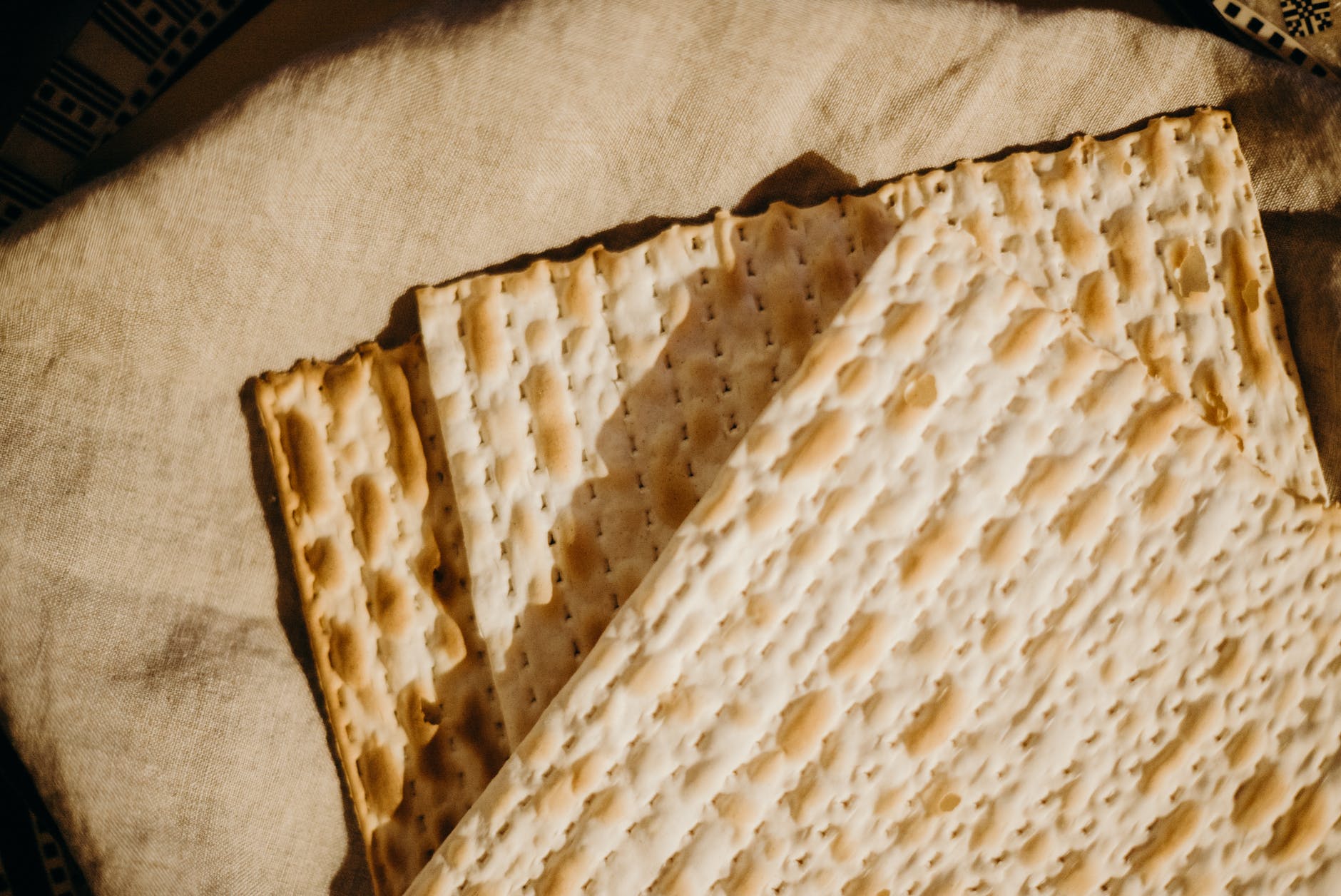
The whole Passover celebration was a reminder of God’s rescue of his people in Egypt. It also looked forward to — and prophecied a coming rescue. He would be sinless, thus the requirement of eating bread untainted by yeast, and sacrificing spotless animals. The feast required a number of sevens — seven days, seven bulls a day, seven rams a day, and repetition of the sacrifices in the seventh month. All of these sevens speak of the completeness of the final rescue. It will not have to be repeated. The Messiah’s atonement will be once for all.

LORD, thank you for your divine plan, fulfilled in Jesus.

Posted in atonement, Jesus Christ | Tagged | Leave a comment