
times of threshing

thresh Isaiah 21.  The punishment that God’s people would face under the oppressor (in this case, Babylon) for their disobedience was like grain, which is crushed to separate it from its chaff, and then violently thrown to the wind for winnowing.  The prophet reassures the people who are going through this painful process that God still loves them. He knows what they are going through. He knows what we are going through as well. In his timing, and according to his plan, the oppressor will fall.

LORD, may your word reassure us of your presence during times of threshing.  May we not forget you during the times of difficulty.
Posted in love, plan of God, relationship with God, suffering | Tagged | Leave a comment

no other gospel

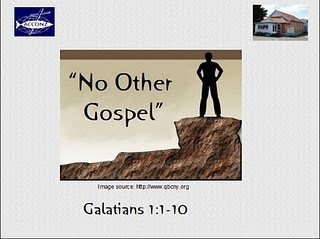
no other gospel Galatians 1:1-10.  You have probably never thought to yourself, “man, I wish I could be circumcised.” So you might be wondering if the message of Galatians is as important today as it was when Paul and the brothers wrote it.

The problem with the troublers in Galatia was not that they were trying to make the Christians more Jewish. They were trying to make the Christians non-Christians. They sought to change the church – to accommodate it to the world around them.

The message of Galatians is that believers should find our distinctiveness in Christ and the gospel of forgiveness through his sacrifice.

LORD, may we live, love, and proclaim no other gospel than the one which brought us salvation: Jesus Christ on the cross to purchase our redemption.

go to sermon

Posted in church, gospel, grace, redemption | Tagged | Leave a comment

false hope

SDC11854 Isaiah 19-20.  It would have been embarrassing to see the great prophet walking around naked and barefoot for three years. The people probably thought that he had finally lost it – that he had gone utterly mad.  All this time they were thinking that God was going to rescue them from the Assyrian threat by means of Egypt and Cush. Then God tells them that it is this false hope that they should be ashamed of.

LORD, forgive us for putting our hope in flesh. It is hard to see your invisible hand, and it is easy to grasp at some other form of rescue, and assume that you are in it. May we put our hope in you alone.

May we who are being tempted to put our hope in the wrong place be reminded of your power and faithfulness. 

Posted in confidence, dependence upon God, discernment, hope, trust, Uncategorized, will of God | Tagged , | Leave a comment

aiming for restoration

SDC12589 2 Corinthians 12:14-13:14.  Paul had visited Corinth two times: once to plant churches there, and then for a “painful visit” in which he had to make judgments and set right wrong behavior.  He is planning a third visit, and wants it to be a positive one, but (as his letter indicates) there are still problems that must be dealt with. He encourages the churches to obey his instructions so that when he returns he does not have to be harsh to them. His prayer and his goal is restoration (13:9), and he encourages the Corinthians to make that their aim as well (13:11). The word restoration suggests an end to the divisions that are crippling the church (1 Cor. 1:10), but it goes beyond that. It suggests repair toward usefulness, like the mending of a net (Matt. 4:21).  Paul sought unity in Corinth for the gospel’s sake.

LORD, help us to restore our unity in you, so that we can together share your gospel with a needy world.

Posted in church, conflict, divisions, gospel, witness | Tagged , | Leave a comment

sometimes God says no

no 2 Corinthians 12:1-10.  As I write this, I am going through a severe spiritual battle.  Something that I really expected to happen has not happened.  Like Paul and his thorn in the flesh, I have prayed many times about this, and was confident that I would get what I prayed for. Nothing. Nada. Zilch.  I am starting to believe that I have missed God’s direction. I feel horrible. Yet, what can I do?  The LORD is the master. I am merely his servant. If he chooses to answer my prayer with a big fat NO, I can only submit to his will.  Perhaps, like Paul, I will have critics who will look at this point in my life and criticize my actions. I don’t know. What I do know is that Paul was eventually vindicated, in spite of the fact that his thorn in the flesh apparently remained unhealed. God’s grace was made perfect in  Paul’s weakness.

LORD, for your sake, make me content with this present answer to my prayers.

Posted in confidence, dependence upon God, faith, faithfulness, obedience, plan of God, submission, will of God | Tagged | 2 Comments

proof of commitment

SDC12585 2 Corinthians 10:13-12:13.  Paul’s opponents in Corinth probably boasted that they were more committed to Christ and the churches than Paul was.  After all, he was only a part-time itinerant missionary, but they demonstrated their commitment by staying among the churches, and sharing their prophecies and visions. Paul — they would say — only writes the occasional letter. Begrudgingly, Paul defends himself against these accusations by pointing out 1) his pedigree — to be a Jewish Christian was to face trouble from Rome for being Jewish and from Jerusalem for being Christian.  2) his troubles — a sign that he is truly committed because he did not give up.  3) his vision — a sign that God is using him in the ministry. 4) his thorn in the flesh — a sign that he is not merely a “fair weather” apostle.  Key to the whole section is the statement: “For it is not the one who commends himself who is approved, but the one whom the Lord commends” (10:18).  The real proof of Paul’s authenticity is the existence of the churches in Paul’s “area of influence.”

LORD, may we seek your approval alone, and follow your directions alone.

Posted in commitment, conflict, divisions, faithfulness, ministry, submission, suffering | Tagged , , | Leave a comment

mighty weapons

SDC12583 2 Corinthians 10:1-12.   Paul has been attacked and his ministry maligned by some within the churches at Corinth. He is careful not to respond in kind, because that would be waging war according to the flesh.  Instead, he writes this letter. He is confident that the words of his letter will convince the true believers in Corinth to repent of their rebellion against his authority. He defends that authority because it was given by Christ for building up believers, not for destroying them. By contrast, the rebels at Corinth were using their authority to suppress Paul’s influence. The words of Paul’s letter remind them of the commands of Christ and the principles taught in scripture. These are mighty weapons in the spiritual realm.

LORD, may we be loyal to those you have appointed as authorities in the church — who teach us your commands and principles.

Posted in church, confidence, divisions, leadership, ministry, scriptures | Tagged | Leave a comment

aiming at what is honorable

SDC12581 2 Corinthians 8:1-9:15.   Paul is sending two men to collect a contribution from the believers in Corinth.  He has been collecting funds from the Gentile churches to help those in Jerusalem who have been hard hit by famine.  He is sending Titus because he trusts him and knows that he is passionate about the ministry, and he is also sending another man “who is famous among all the churches for his preaching of the gospel.”  Paul does not mention the man’s name, but he assumes that the Corinthians would recognize him.  Paul explains that “We take this course so that no one should blame us about this generous gift that is being administered by us, for we aim at what is honorable not only in the Lord’s sight but also in the sight of man” (20-21).  When it comes to fundraising, believers should be extra cautious not to bring shame to the name of Christ or his church.

LORD, may we give generously, but be careful not to shame you by our fund-raising.

Posted in giving, integrity, ministry, witness | Tagged , | Leave a comment

things that defile

SDC12579 2 Corinthians 6:11-7:16.  The temple under the old covenant was a building in Jerusalem, and it could be defiled by people who came in contact with certain things: a dead body, certain animals, etc.  Since the death of Christ on the cross, God has instituted a new covenant, in which the temple is now the lives of believers. That temple can be defiled as well.  Here, Paul points out two things that were defiling the temple at Corinth. 1) partnerships with unbelievers (6:14-7:1). 2) worldly grief [which the ESV Study Bible defines as “remorse brought about by losing the world’s approval”]. 

LORD, we resolve to cleanse ourselves of those things that defile, and serve you wholeheartedly.

Posted in faithfulness, forgiveness, genuineness, holiness, idolatry, obedience, relationship with God | Tagged , | Leave a comment

fully loaded

lrg_Sword_and_shield_icon 2 Corinthians 5:11-6:10.  Paul described himself and the other missionaries who worked with him as having a weapon in each hand (6:7).  Perhaps he was picturing a Roman soldier with a sword in one hand and a shield in the other.  Maybe he was pointing out that both the times when the missionaries seem to be successful,  and the times when they had setbacks, God was at work.  Perhaps that is why he mentioned the death of Christ here.  In the flesh, the cross seemed a defeat, but in reality, God was reconciling the world to himself (5:19) making it possible for us sinners to become new creations and have his righteousness (5:17, 21).  In the same way, when the servants of God suffer hardship for Christ, they commend themselves because by suffering for him they honor him. 

LORD, use us how you see it. May we magnify you through our victories, and honor you in our struggles.

Posted in faithfulness, Jesus Christ, ministry, perseverance, suffering, the cross, witness | Tagged , | Leave a comment