Abram: competition

hs-2002-10-c-webGenesis 13:2-18.  Abram and Lot travel back to the promised land with all their people and livestock and stuff.  They stop for a very important prayer meeting at the place where Abram had built an altar before – between Bethel and Ai.  This was a very significant spot, because it would come to represent the two kinds of competition that the Israelites would face in the conquest of the land centuries later.

  1. Bethel was a major city at the time and represented the external competition which at the time of Abram was the Canaanites and the Perizzites (7).
  2. Ai looked eastward toward the cities of Sodom and Gomorrah. It represented internal competition of lust and greed.  It was this land that Lot chose (11).  It would later be at Ai that Achan would sin by keeping back some of the devoted loot (Joshua 7:1-26).

LORD, we call upon your name, and ask you to keep us from all things that would deprive us of our eternal inheritance.


Posted in Abraham, commitment, dependence upon God, faith, truth | Tagged | 1 Comment

Abram: exodus from Egypt

hs-2002-10-c-webGenesis 12:1-13:1.   Moses wanted the Israelites that God had promised them the land of Canaan long before they set foot in Egypt.  The promise was made to Abram, while he was still in Ur.  Terah got him as far as Haran, and died there. Abram went with all his possessions (sound familiar?) God had promised to bless him, and bless those who blessed him – and curse (sound familiar?) those who cursed him.  They didn’t say in the promised land long, before famine (sound familiar?) forced them to seek refuge in Egypt (sound familiar?) where Pharaoh sent them on an exodus to Canaan (sound familiar?) after experiencing great plagues (sound familiar?) because he had taken Sarai.

This whole story was déjà vu for the Israelites.  The history of their ancestor told them that they were in the right place.

LORD, though times may be hard for us, we know that in you we are where we are supposed to be.  We will trust in you.

Posted in Abraham, dependence upon God, plan of God, trust | Tagged , | 1 Comment

first look at the nation God chose

vayyafetsGenesis 11.  Moses now transitions his narrative to focus not on God’s dealings with the whole of humanity, but with one particular nation.  The story of Babel (1-9) explains why God is doing that.  Left alone, the nations gather together in a city and propose a building project.  God’s expressed will was for them to scatter over the face of the whole earth.  They would not do that.  So, God purposely changed their language so that their differences would do what their unity would not.

Next, Moses provides the genealogy of Shem to Abram (10-30) and explains how Abram got to Haran (31-32).  The past eleven chapters is prologue to what happens next.

LORD, forgive us for choosing to do things that are against your will.  May we be among those whom you set apart to bring blessing by our obedience.

Posted in adoption, discipleship, faithfulness, sovereignty of God | Tagged | 1 Comment

first look at the nations God loves

vayyivalduGenesis 9:20-10:32.   This section highlights the event leading to Noah’s curse upon his grandson, Canaan, in retaliation for his son Ham’s humiliation of him.  Moses probably wanted to recount this story because it gave justification for the Israelites moving to the promised land.  Noah had predicted that Canaan would be the servant of Shem (9:26).

But Moses lists all the descendants of Noah here – not just those of Shem, from whom the Israelites came.  God has a plan for all nations – not just the one through whom the Messiah will come.  He wants to bless all the nations through his chosen one.  He rescued all three of Noah’s sons with the ark.  He wants to rescue all their descendants with the cross, because he loves them all.

LORD, give us your heart for all nations, not just our own.

Posted in deliverance, ethnic Israel, evangelism, Jesus Christ, missions | Tagged , | Leave a comment

first look at a second covenant

vezachartiGenesis 8:20-9:19.  God has just lashed out in fierce anger over the sinfulness and corruption of humanity, and destroyed almost every living thing on the planet.  If God is like this, how will life survive?

God makes a covenant with Noah and all the creatures of the earth.  He promises not to ever destroy the earth with  a flood again.  He requires that human life be protected by the principle of talion,  a life for a life.  He presents a rainbow as the sign of this new covenant of protection.  When rain clouds appear, the bow will be there, reminding the planet that God – who can destroy us – has decided to save us.

LORD, thank you for the sign of your decision to save life.  Thank you for the cross.

Posted in deliverance, grace, hope, new covenant, the cross | Tagged , | 1 Comment

first look at a second chance

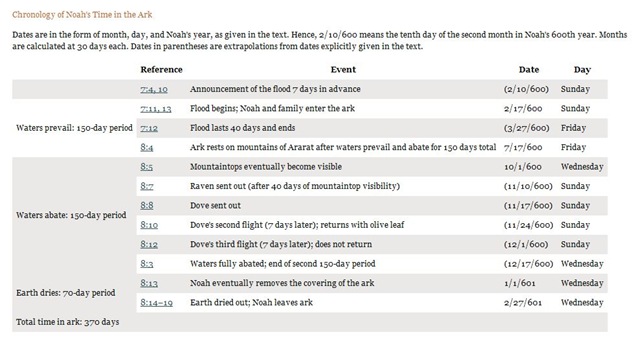
vayyachelGenesis 8:1-19.  The imagery and wording of this section echoes Genesis 1.  God is making a new heavens and a new earth.  The Hebrew verb in 8:10 suggests that Noah anxiously longed for this, like a woman in childbirth. Noah and his family had been in the ark for over a year. It was a long wait for a second chance.

arktime

(source: ESV Study Bible, page 63).

We –believers – are presently in God’s ark of safety until he destroys all things with fire at Christ’s second coming.  We are in a long wait for our second chance as well.   The difference is that there is still an opportunity for us to bring others into the cross for rescue.

LORD, thank you for the second chance at eternal life in your favor.  May we use this long time of waiting to compel others to leave their destruction and seek your second chance.

Posted in deliverance, destruction in hell, evangelism, grace, Jesus Christ, patience, second coming, witness | Tagged | 1 Comment

first look at destruction by justice

vayyimachGenesis 7.  The flood that came upon the earth in Noah’s day was a cataclysmic event beyond all proportions.  It cannot be compared with any natural disaster that has happened since.  God in his grace has allowed Noah to rescue his own family and prepare for their needs while in the ark.  But it was time for justice.  God said “every living thing that I have made I will blot out from the face of the ground (4).  God’s justice prevailed.  “He blotted out every living thing that was on the face of the ground” (22).  “Only Noah was left, and those who were with him in the ark” (23).

LORD, we thank you for your redeeming grace, which has rescued us.  But we tremble to think of your inevitable justice which is coming to this earth again – this time by a consuming fire.  Help us to reach all that we can so that they also can find safety inside your cross.

Posted in destruction in hell, grace, judgment, redemption | Tagged | 1 Comment

first look at deliverance by grace

matsa chenGenesis 6.  We have already seen in Genesis how God’s grace is present even in the midst of his judgment.  Here we see grace at work delivering people from the consequences of their own sins.

  1. The judgment is real and its motivation is just.  God did not have to wait several centuries to see a world filled with unrighteousness.  Total depravity grieves God’s heart.
  2. He chooses a man.  Noah is blameless in his generation, but he does not stay that way (9:20-27).  God, who sees the future, knows that Noah is not the perfect specimen of humanity, but he chooses to love him anyway.
  3. He prescribes a plan.  The ark is the means that God will use to preserve humanity from the flood.  The cross is the means of delivering us from destruction in hell.

LORD, we all deserve your wrath. Thank you for delivering us by your grace.

Posted in atonement, deliverance, destruction in hell, grace, Jesus Christ, plan of God | Tagged | 1 Comment

first look at natural death

vayyamotGenesis 5.  This chapter traces the family tree of Adam until the time of Noah.  besides that, it also is a clear reminder that what God warned Adam about in the garden of Eden will happen.  Now that humanity has transgressed the prohibition of the tree of the knowledge of good and evil, we share the same destiny.  We die.  It took Adam 930 years but he eventually succumbed to natural death (5).  The others followed.  At the end of each story, there is an inevitable “and he died”  (5,8,11,14,17,20,27,31).  The only exception appears to be Enoch, and we don’t really know what happened to him.  He was not found.  The point of this passage is that death is a constant, and it will be until our Lord returns to abolish it at the resurrection.

LORD, we tremble at the awareness of our own mortality.  but we trust that you will make us alive again when Christ returns.  Our destiny is in your hands.

Posted in dependence upon God, mortality, resurrection | Tagged | Leave a comment

first look at murder

rovetsGenesis 4.  Cain’s offering had disappointed God.  The reason was that God looked not at the offering, but at the heart of the offerer.  God warned Cain that he had a choice.  He could rule over his sinful heart, or he could allow it to overcome him.  He chose sin and death.  He murdered his brother.

God had been watching.  He banished Cain, forcing him to abandon the ground, because the ground would abandon him.  He would be a fugitive and wanderer on the earth, and he and his descendants would not be known for their farming skills.  His descendants would also inherit his lack of self-control.  Seven generations later, the lust for vengeance is still active in his family, as is demonstrated by Lamech’s poem.

LORD, heal our hearts.  Sin seeks to consume us, as it did Cain.  Most of us do not murder, but all of us have murder in our hearts, like a crouching beast waiting to pounce (7).  Grant us the fruit of your Holy Spirit – which is self-control.

Posted in Holy Spirit, self-control, the flesh, vengeance | Tagged | 1 Comment