Ezekiel 46:9 “When the people of the land come before Yahveh at the appointed times, whoever enters by way of the north gate to worship is to go out by way of the south gate, and whoever enters by way of the south gate is to go out by way of the north gate. No one may return through the gate by which he entered but is to go out by the opposite gate. Ezekiel 46:10 When the people enter, the prince will enter with them, and when they leave, he will leave.
going out the opposite gate
I like this little rule because it demonstrates the fact that encounter with God in worship is designed to change us. We are not to leave the way we came, because we should not be the same people after our encounter with God.
Ezekiel 46:1 “This is what the Lord Yahveh says: The gate of the inner court that faces east is to be shut during the six days of work, but it will be opened on the Sabbath day and opened on the day of the New Moon. Ezekiel 46:2 The prince should enter from the outside by way of the gate’s portico and stand at the gate’s doorpost while the priests sacrifice his burnt offerings and fellowship offerings. He will bow in worship at the gate’s threshold and then depart, but the gate is not to be shut until evening. Ezekiel 46:3 The people of the land will also bow in worship before Yahveh at the entrance of that gate on the Sabbaths and New Moons. Ezekiel 46:4 “The burnt offering that the prince presents to Yahveh on the Sabbath day is to be six unblemished lambs and an unblemished ram. Ezekiel 46:5 The grain offering will be an ephah with the ram, and the grain offering with the lambs will be whatever he wants to give, as well as a hin of oil for every ephah. Ezekiel 46:6 On the day of the New Moon, the burnt offering is to be a young, unblemished bull, as well as six lambs and a ram without blemish. Ezekiel 46:7 He will provide a grain offering of an ephah with the bull, an ephah with the ram, and whatever he can afford with the lambs, together with a hin of oil for every ephah. Ezekiel 46:8 When the prince enters, he is to go in by way of the gate’s portico and go out the same way.
deliverance and renewal
Craigie writes: “Although worship and sacrifices were offered on a daily basis in the temple, Sabbath days and the first day of each new month (viz. “the new moon”, the calendar being a lunar system) were times of special worship. Throughout the week, the eastern gate of the temple’s inner court was kept closed, but it was opened each Sabbath and on the first day of each month. The people as a whole would worship in the outer court; they could look through the eastern gate to the altar in the inner court where the sacrifices were offered, but they were not permitted to enter. Only the prince could pass through the vestibule of the eastern gate; he was not to go directly into the inner court but was allowed to stand by the inner gatepost and observe the priests offer his offerings. There then follows a list of the various offerings specified for the Sabbath worship and for the first day of the month, which the prince provided on behalf of his people as a whole (verses 4-7)” (Craigie, 306).
The people were not permitted to enter the inner court because their function in the visual prophecy is to receive what God is doing for them. Each Sabbath, they rested. The work of deliverance was by God’s grace and through his coming sacrifice. Each new moon, they celebrated the coming renewal, which was also to be provided miraculously by God’s grace, apart from their actions.
Craigie, Peter C. Ezekiel. Edinburgh: Saint Andrew Press, 1983.
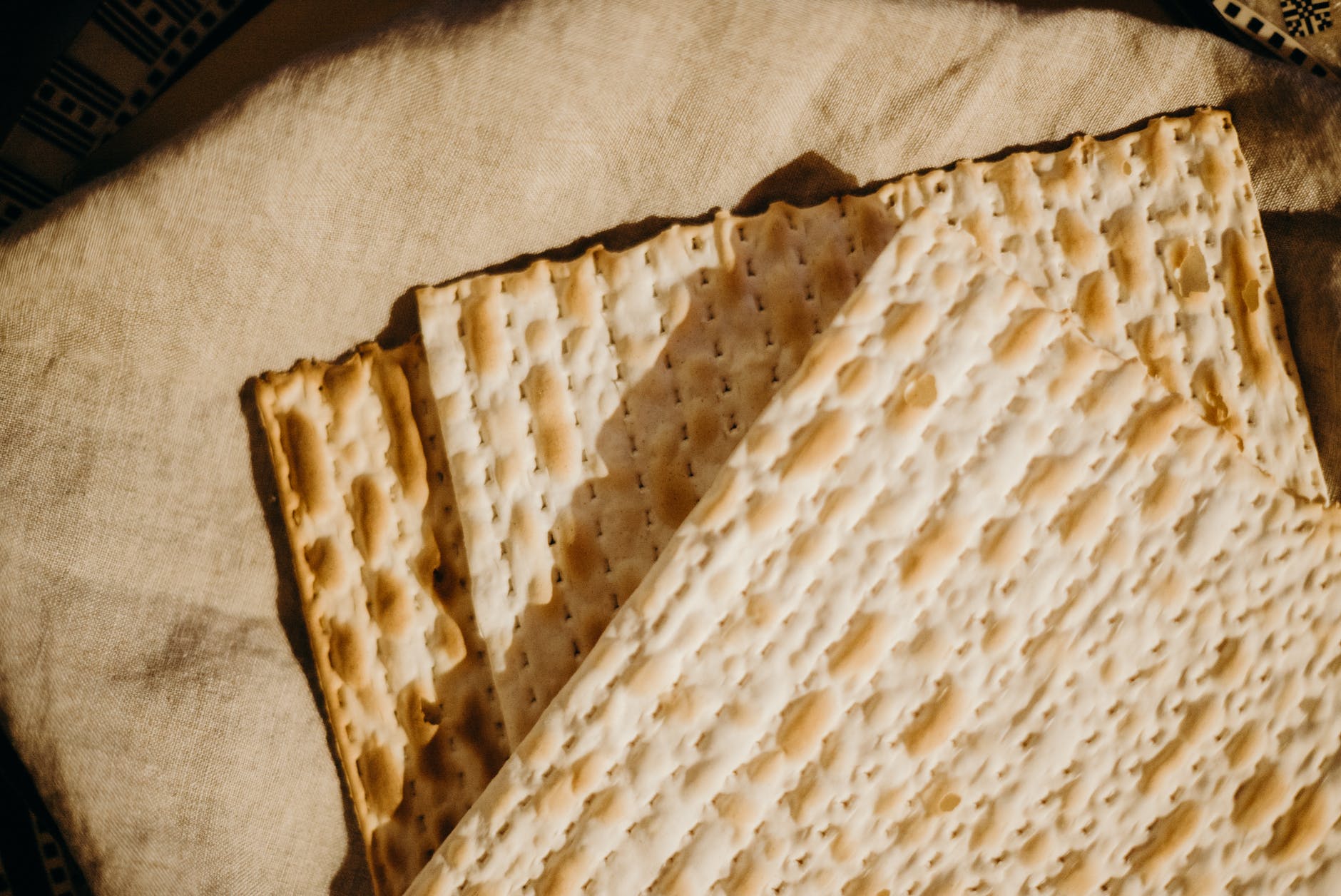
Ezekiel 45:21 “In the first month, on the fourteenth day of the month, you are to celebrate the Passover, a festival of seven days during which unleavened bread will be eaten. Ezekiel 45:22 On that day the prince will provide a bull as a failure offering on behalf of himself and all the people of the land. Ezekiel 45:23 During the seven days of the festival, he will provide seven bulls and seven rams without blemish as a burnt offering to Yahveh on each of the seven days, along with a male goat each day for a failure offering. Ezekiel 45:24 He will also provide a grain offering of an ephah per bull and an ephah per ram, along with a hin of oil for every ephah. Ezekiel 45:25 At the festival that begins on the fifteenth day of the seventh month, he will provide the same things for seven days – the same failure offerings, burnt offerings, grain offerings, and oil.
unleavened, unblemished, seven days
The whole Passover celebration was a reminder of God’s rescue of his people in Egypt. It also looked forward to — and prophecied a coming rescue. He would be sinless, thus the requirement of eating bread untainted by yeast, and sacrificing spotless animals. The feast required a number of sevens — seven days, seven bulls a day, seven rams a day, and repetition of the sacrifices in the seventh month. All of these sevens speak of the completeness of the final rescue. It will not have to be repeated. The Messiah’s atonement will be once for all.
LORD, thank you for your divine plan, fulfilled in Jesus.
Ezekiel 45:18 “This is what the Lord Yahveh says: In the first month, on the first day of the month, you are to take a young, unblemished bull and purify the sanctuary. Ezekiel 45:19 The priest is to take some of the blood from the failure offering and apply it to the house doorposts, the four corners of the altar’s ledge, and the doorposts of the gate of the inner court. Ezekiel 45:20 You are to do the same thing on the seventh day of the month for everyone who fails unintentionally or through ignorance. In this way you will make atonement for the house.
atonement for the house
Since the temple is God’s house, why did the people have to purify it, and make atonement for it with blood? The answer is human failure. That is why there had to be blood spilt — on New Years’ Day, and six days afterward. Humans fail deliberately and unintentionally. But God’s worship requires purity.
Under the new covenant, it is not the blood of bulls that is required, but the blood of Christ shed on the cross is sufficient for all sin. He made atonement for the house and all the people.
Ezekiel 45:13 “This is the contribution you are to offer: Three quarts from five bushels of wheat and three quarts from five bushels of barley. Ezekiel 45:14 The quota of oil in liquid measures will be one percent of every cor. The cor equals ten liquid measures or one standard larger capacity measure since ten liquid measures equal one standard larger capacity measure. Ezekiel 45:15 And the quota from the flock is one animal out of every two hundred from the well-watered pastures of Israel. These are for the grain offerings, burnt offerings, and fellowship offerings, to make atonement for the people.” This is the declaration of the Lord Yahveh. Ezekiel 45:16 “All the people of the land must take part in this contribution for the prince in Israel. Ezekiel 45:17 Then the burnt offerings, grain offerings, and drink offerings for the festivals, New Moons, and Sabbaths – for all the appointed times of the house of Israel – will be the prince’s responsibility. He will provide the failure offerings, grain offerings, burnt offerings, and fellowship offerings to make atonement on behalf of the house of Israel.
the three parties of worship
The order of the contribution is significant. The people contribute to the prince. The prince provides for the offerings. This establishes a connection between the three parties of worship: the people, the leader, and the LORD. This is not a private religion. Everyone is connected. Everyone matters.
Ezekiel 45:9 “This is what the Lord Yahveh says: You have gone too far, princes of Israel! Put away violence and oppression and do what is just and right. Put an end to your evictions of my people.” This is the declaration of the Lord Yahveh. Ezekiel 45:12 “You are to have honest scales, an honest dry measure, and an honest liquid measure. Ezekiel 45:11 The ephah and the bath should be of the same measure, the bath containing one-tenth of a homer, and the ephah one-tenth of a homer; the homer shall be the standard measure. Ezekiel 45:12 The shekel will weigh twenty gerahs. Your mina will equal sixty shekels.
leading under God’s leadership
God challenges the leaders to have honest scales — to show what integrity means. We need to put away corruption, dishonesty, and greed, and lead under God’s leadership.
LORD, give us the wisdom to lead with honesty and integrity.
Ezekiel 45:7 And the prince will have the area on each side of the devoted donation of land and the city’s property, adjacent to the devoted donation and the city’s property, stretching to the west on the west side and to the east on the east side. Its length will correspond to one of the tribal portions from the western boundary to the eastern boundary. Ezekiel 45:8 This will be his land as a possession in Israel. My princes will no longer oppress my people but give the rest of the land to the house of Israel according to their tribes.
God’s kind of politics
The leader is to have land next to that assigned to the priests, but he is not to steal land from the people. God wants his political leaders to serve him, and protect the people. That is God’s kind of politics.
Ezekiel 45:1 “When you divide the land by lot as an inheritance, set aside a donation to Yahveh, a devoted portion of the land, 25,000 cubits long and 20,000 cubits wide. This entire region will be devoted. Ezekiel 45:2 In this area there will be a square section for the sanctuary, 500 by 500 cubits, with 50 cubits of open space all around it. Ezekiel 45:3 From this devoted portion, you will measure off an area 25,000 cubits long and 10,000 cubits wide, in which the sanctuary, the most devoted place, will stand. Ezekiel 45:4 It will be a devoted area of the land to be used by the priests who minister in the sanctuary, who approach to serve Yahveh. It will be a place for their houses, as well as a devoted area for the sanctuary. Ezekiel 45:5 There will be another area 25,000 cubits long and 10,000 cubits wide for the Levites who minister in the house; it will be their possession for towns to live in. Ezekiel 45:6 “As the property of the city, set aside an area 5000 cubits wide and 25,000 cubits long, adjacent to the devoted donation of land. It will be for the whole house of Israel.
a section of land
Worship was so important that a section of land was to be set aside for the priests to use. The land was the major means of wealth, so this was in itself a major sacrifice.
LORD, may we be wise enough to devote significant portions to your ministry.
Ezekiel 44:28 “This will be their inheritance: I am their inheritance. You are to give them no possession in Israel: I am their possession. Ezekiel 44:29 They will eat the grain offering, the failure offering, and the guilt offering. Everything in Israel that is permanently dedicated to Yahveh will belong to them. Ezekiel 44:30 The first of all the firstfruits of every kind and contribution of every kind from all your gifts will belong to the priests. You are to give your first batch of dough to the priest so that a blessing may rest on your homes. Ezekiel 44:31 The priests may not eat any bird or animal that died naturally or was mauled by wild beasts.
the first batch goes to the priest
The people are told to bless their priests, and a corresponding blessing would rest on their homes. But if the priest got second best, there would be no blessing for the home.
God is watching to see how we really feel about those who serve him among us. We can declare all we want in the assemby, but the real test of our love for God is how we demonstrate our appreciation for him and his worship.
LORD, give us the wisdom to show our love to you by blessing your servants.
Ezekiel 44:15 “But the Levitical priests descended from Zadok, who kept charge of my sanctuary when the Israelites went astray from me, will approach me to serve me. They will stand before me to offer me fat and blood.” This is the declaration of the Lord Yahveh. Ezekiel 44:16 “They are the ones who may enter my sanctuary and approach my table to serve me. They will keep my mandate. Ezekiel 44:17 When they enter the gates of the inner court they are to wear linen garments; they must not have on them anything made of wool when they minister at the gates of the inner court and within it. Ezekiel 44:18 They are to wear linen turbans on their heads and linen undergarments around their waists. They are not to put on anything that makes them sweat. Ezekiel 44:19 Before they go out to the outer court, to the people, they must take off the clothes they have been ministering in, leave them in the devoted chambers, and dress in other clothes so that they do not transmit devotion to the people through their clothes. Ezekiel 44:20 “They may not shave their heads or let their hair grow long, but are to carefully trim their hair. Ezekiel 44:21 No priest may drink wine before he enters the inner court. Ezekiel 44:22 He is not to marry a widow or a divorced woman but may marry only a virgin from the offspring of the house of Israel, or a widow who is the widow of a priest. Ezekiel 44:23 They are to teach my people the difference between the devoted and the common and explain to them the difference between the clean and the unclean. Ezekiel 44:24 “In a dispute, they will officiate as judges and decide the case according to my rules. They are to observe my laws and prescriptions regarding all my appointed festivals and keep my Sabbaths sacred. Ezekiel 44:25 A priest may not come near a dead person so that he becomes defiled. However, he may defile himself for a father, a mother, a son, a daughter, a brother, or an unmarried sister. Ezekiel 44:26 After he is cleansed, he is to count off seven days for himself. Ezekiel 44:27 On the day he goes into the sanctuary, into the inner court to minister in the sanctuary, he is to present his failure offering.” This is the declaration of the Lord Yahveh.
an example and an explanation
Craigie writes ” In their dress, appearance, and personal hygiene, the priests were to be clean, both literally and in terms of ritual purity. The same sense of cleanliness was to be maintained in such matters as marriage and encounters with the dead. They had responsibility for religious education, legal consulting and adjudication, and the conduct of worship at the temple’s altar. Their whole life was to be the service of God…” (297).
What would our world be like if all believers (priests under the new covenant) would set themselves a higher standard of living? We could be an example and an explanation to unbelievers as to what holiness is and who God is.
______
Craigie, Peter C. Ezekiel. Edinburgh: Saint Andrew Press, 1983.










 Devotions