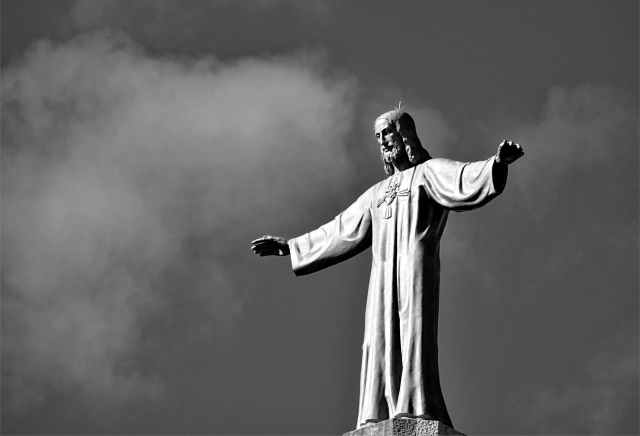
My throat is melting away; that is why I remember you from the land of Jordan and the peaks of Hermon, from Mount Mizar.
not even close
I’ve lived in a number of places in the world which the locals call “God’s country.” They cannot image it getting any better than where they are. John Denver was at least a little closer to the truth when he sang about West Virginia being “almost heaven.”
The psalmist was in a place that only reminded him of what he had lost. He tried to cultivate an awareness of God’s presence all around him in the mountains of Hermon and Mizar, and it was hard. He was used to worshiping God at Jerusalem, of the joys of Mount Zion.
Where he was he could not call “almost heaven.” It was not even close. But he had to get his mind off his location and circumstances and remember that God is everywhere, and he never changes.
Lord, thank you that no matter where we are, you are with us. We want to feast upon your abundance, and warm ourselves on your power – right here, right now.
Why, my throat, are you melting away?¹ Why are you in such uproar? Put your hope in God, because I will still praise him, my Savior and my God.
things are bad, but
Things are bad. Is that reason to give up? Of course not. Nothing can be so bad that it cannot get better. He is our Savior and our God, so there is every reason to put our hope in him, trusting that his blessings will come, and we will still praise him.
Lord, we acknowledge that things are bad, but you are good. We will praise you now for who you are, and we will still be praising you when things get better.
______________________
¹ שׁיח = melt away. Psalm 42:5-6; 43:56.
Another Bible Commentary
A devotional commentary on every passage in the Bible (based on the English Standard Version –ESV).
I remember this as I pour out my heart: how I used to walk with many, leading the festive procession to the house of God, with joyful shouts and thankfulness.
memories of worship
When people keep asking the psalmist where God is, his mind goes to the past. He remembers worship so spectacular and so joyful that he did not need to ask where God was. He knew that his God was there, 100% present in the moment.
We need to cultivate worship experiences like that. There will certainly be times in our lives when the circumstances test our trust in the presence and care of God. At such times, we need memories like this – memories that rush us back into the eternal reality that God is always 100% here.
Psalm 42:1¹ Like a deer longing for flowing streams, that’s how I long for you, God.
Psalm 42:2 I thirst for God, the living God. When can I come and see God’s face?
Psalm 42:3 My tears have been my food day and night, while all day long people say to me, “Where is your God?”
getting to the stream
I have hiked over a thousand miles, and I have encountered numerous deer. They like to hang out at the flowing streams, because they also travel many miles every day. God puts the streams where they need to be, but the deer cannot just lie down and cry out for God to give them water. They have to go to the streams.
The psalmist is like that too. He cannot just lie in his bed and cry out for God to come to him. Everyone around him is wondering where his God is. If he cannot find God where he is, he has to keep traveling until he meets him. That is why he is asking “When can I come and see God’s face?”
As small children, we learn that if we yell for mom or dad they will come, but as we mature, we learn that it is not really respectful for us to keep doing that. Instead, we should look for our parents if we need them. The same is true with our Father in the sky. By his grace, he is usually available when we call out in prayer. But, as we mature as his children, there will be times when he expects us to come to him.
Lord, we thirst for your presence. Show us how to get to where you are!
___________________
¹ superscription: “For the choir director. A Maskil of the sons of Korah.”
Philippians 4:21 Greet every devotee in Christ Jesus. The brothers who are with me send you greetings.
Philippians 4:22 All the devotees send you greetings, especially those who belong to Caesar’s household.
Philippians 4:23 The favor of the Lord Jesus Christ be with your breath.
Caesar’s householdPaul’s closing greeting is more than a polite farewell. It is a quiet declaration that the gospel has continued to advance in places where no one expected it to take root. The believers who send greetings are not from comfortable congregations or familiar mission fields. They are members of the community in which Paul is being held—people who have come to faith because Paul was detained, not in spite of it. Whatever strategy the Adversary imagined, whatever hope there was of silencing the apostle by locking him away, the plan has failed. The gospel has slipped past the bars, entered the halls of power, and taken hold in the very household of Caesar.
Paul’s imprisonment has not severed his connection to the churches. It has not halted his ministry. It has not diminished his influence. He remains deeply woven into the life of the congregations he loves, and he continues to shape new believers even while chained. The letter itself is evidence of this ongoing work—pastoral care carried out from confinement, encouragement written from a place the empire assumed would neutralize him. Instead, the prison becomes a pulpit.
This closing scene reveals something essential about the nature of God’s mission. Human obstacles do not cancel divine calling. Barriers that appear immovable from the outside become instruments in God’s hands. Paul’s confinement becomes the doorway through which the gospel enters Rome’s inner circles. The guards assigned to watch him become witnesses to Christ. The imperial household becomes a field ready for harvest. The very forces meant to restrict him become the means by which his influence expands.
The principle that emerges is not triumphalism but trust. When God entrusts a mission, he also provides the path for its fulfillment. The path may not be smooth. It may involve hardship, limitation, or unexpected detours. Yet none of these can overturn God’s intention. Paul’s experience shows that divine purpose is not fragile. It does not depend on ideal circumstances. It does not collapse under pressure. Even the machinery of empire cannot prevent God from reaching the people he intends to reach.
The greeting from Caesar’s household stands as a final reminder: God’s work continues even in the places that seem most resistant. The mission entrusted to a servant of Christ will find its way forward, and no earthly power can close the doors God chooses to open.
Lord, we trust you to use us to accomplish your purpose, no matter what.
Philippians 4:15 And you Philippians know that when we first1 started sharing the gospel, when I left Macedonia, no congregation partnered with me in the word about giving and receiving except you alone.
Philippians 4:16 You see, even in Thessalonica you sent gifts for my need several times.
Philippians 4:17 Not that I seek the gift, but I seek the profit that is increasing when people share the word through you.
Philippians 4:18 But I have received everything in full, and I have an abundance. I am fully supplied, having received from Epaphroditus what you provided – a fragrant offering, an acceptable sacrifice, pleasing to God.
Philippians 4:19 And my God will supply all your needs according to his riches in glory in Christ Jesus.
Philippians 4:20 Now to our God and Father be glory for ages2 and ages. Amen.
God will supplyThe line is so familiar, so frequently quoted, that it has taken on a life of its own. It is recited as a universal guarantee, a kind of spiritual blank check: “God will supply all needs.” Many treat it as a promise that activates itself simply by being spoken. But Paul is not offering a formula. He is not handing out a slogan to be used in prayers as if repetition could force God’s hand. He is speaking to a specific congregation about a specific situation, and his confidence rests on something concrete: their demonstrated generosity.
The Philippian believers had supported Paul when others hesitated. They sent help when he was hungry, when he was imprisoned, when he had no way to provide for himself. They cared for the needs of the missionary team God had sent out with the gospel. Their giving was not theoretical. It was sacrificial, consistent, and costly. They did not wait for ideal circumstances. They did not give only when it was convenient. They gave because they believed in the mission and loved the messenger.
This is why Paul can speak with such assurance. He is not making a general statement about how God treats all believers in all circumstances. He is affirming what he knows to be true about God’s character in response to the Philippians’ faithfulness. They had poured themselves out for the sake of the gospel, and Paul is convinced that God will pour back into them everything they need. Their generosity toward God’s work becomes the soil in which God’s provision grows. The promise is tied to partnership.
This does not diminish God’s care for all believers. It simply honors the context. Paul is not encouraging a passive expectation that God will supply needs regardless of commitment or participation in the mission. He is recognizing a spiritual pattern: those who invest in the work of the gospel become participants in the flow of God’s provision. Their giving aligns them with God’s purposes, and God delights to sustain those who sustain his servants.
So the question is not whether the verse is true. It is whether the conditions that made it true for the Philippians are present. Paul’s gentle test cuts through sentimentality and self‑deception. It is not meant to shame but to clarify. If the promise is being claimed, the evidence of partnership should be visible. In other words: check the check stubs.
Lord, make us a people who consistently support your missions work.
Philippians 4:10 I rejoiced in the Lord greatly because once again you renewed your care for me. You were, in fact, concerned about me but lacked the opportunity to show it.
Philippians 4:11 I don’t say this due to my need, because I have learned to be content in whatever circumstances I find myself.
Philippians 4:12 I know both how to make do with little, and I know how to make do with a lot. In any and all circumstances I have learned the secret of being content – whether well fed or hungry, whether in abundance or in need.
Philippians 4:13 I am able to cope with all things through him who strengthens me.
Philippians 4:14 On the other hand, you did well by partnering with me in my hardship.
able to cope
The text has been stretched so far by prosperity‑gospel interpreters that its original shape is almost unrecognizable. Paul is not urging believers to visualize success, expand their ambitions, or imagine themselves capable of limitless achievement. Nothing in his words suggests personal empowerment, self‑actualization, or triumphant self‑confidence. The tone is not boastful. It is grateful. The context is not a motivational speech. It is a missionary’s thank‑you letter.
Paul writes from a place of real vulnerability. There were seasons when ministry flourished, when he could preach freely, travel widely, and support himself honorably through tent‑making. In those years he experienced the dignity of providing for his own needs while pouring himself into the congregations he served. But there were also long stretches when circumstances stripped away that independence. Imprisonment cut off his ability to work. Ancient prisons did not supply food or clothing. Survival depended entirely on the generosity of friends and the faithfulness of supporting congregations. The Philippians stepped into that gap. They sent coworkers, financial gifts, and practical help. Their partnership kept him alive.
This is the setting in which Paul speaks of doing “all things.” The phrase does not describe boundless capability. It describes endurance. It reflects a man who has learned to live with open hands, receiving abundance without pride and scarcity without despair. God had schooled him in contentment, not by shielding him from hardship but by sustaining him through it. The strength Christ provided was not the power to accomplish every dream but the grace to remain faithful in every circumstance.
Paul’s gratitude flows from this lived experience. He recognizes that God’s provision often arrives through the hands of God’s people. The Philippians’ generosity became the means by which Christ strengthened him. Their partnership in the gospel was not theoretical. It was embodied in real sacrifices, real money, real care. Because of this support, Paul could continue his mission whether conditions were favorable or crushing.
The statement, then, is not a declaration of personal triumph but a confession of divine sufficiency. Paul has learned that Christ is enough in hunger and in plenty, in freedom and in chains. The strength he celebrates is the quiet resilience that comes from trusting God and receiving the faithful care of the church.
Lord, give us the spiritual strength that will help us to cope — to be content in times of plenty and times of hunger.
Philippians 4:4 Rejoice in the Lord always. I will say it again: Rejoice!
Philippians 4:5 Let your restraint be known to every human. The Lord is near.
Philippians 4:6 Don’t worry about anything, but in everything, through prayer and petition with thanksgiving, present your requests to God.
Philippians 4:7 And the peace of God, which surpasses all understanding, will guard your hearts and minds in Christ Jesus.
Philippians 4:8 Finally brothers and sisters, whatever is true, whatever is honorable, whatever is just, whatever is pure, whatever is lovely, whatever is commendable – if there is any moral excellence and if there is anything praiseworthy – dwell on these things.
Philippians 4:9 Do what you have learned and received and heard from me, and seen in me, and the God of peace will be with you.
unlocking joy
Paul’s command to “rejoice always” can feel impossible when joy seems distant or locked behind the weight of circumstances. Scripture never denies that believers experience sorrow, fatigue, or seasons when joy feels inaccessible. Paul himself knew imprisonment, conflict, disappointment, and physical weakness. Yet he still urged the Philippians to rejoice—not because joy is always felt, but because joy in the Lord is rooted in something deeper than emotion.
Paul does not call for a vague, generic happiness. He points to a specific kind of joy: joy in the Lord. This joy is anchored in God’s character, God’s presence, and God’s promises. It is not dependent on mood or circumstance. It is cultivated through spiritual habits that open the heart to God’s peace and truth. Paul gives several guidelines that show how this joy is unlocked and sustained.
Joy in the Lord is not ecstatic, unbridled emotion. It is joy characterized by restraint. Paul pairs rejoicing with gentleness, showing that Christian joy is steady, calm, and rooted. It is not the frantic excitement of a moment but the settled confidence that the Lord is near. This kind of joy can coexist with tears, because it is not fragile or shallow.
Joy in the Lord comes from hearts and minds guarded by peace. Paul connects rejoicing with prayer—bringing anxieties before God with thanksgiving. When believers do this, the peace of God stands guard over their inner life. That peace becomes the environment in which joy can breathe. Without peace, joy suffocates. With peace, joy grows quietly and steadily.
Joy in the Lord comes from dwelling on morally excellent and praiseworthy things. Paul directs the Philippians to fill their minds with what is true, honorable, just, pure, lovely, commendable, excellent, and worthy of praise. Joy is shaped by what the mind feeds on. When attention is fixed on what is corrupt, fearful, or trivial, joy withers. When the mind is trained on what reflects God’s goodness, joy finds room to flourish.
Joy in the Lord comes from following the good example of spiritual leaders. Paul urges the Philippians to practice what they have seen in him. Joy is not only taught; it is caught. Watching the faithfulness of mature believers—especially those who rejoice in hardship—teaches the heart how to rejoice in the Lord.
In all these ways, Paul shows that rejoicing always is not an emotional command but a spiritual posture. It is the fruit of peace, disciplined thought, and Christlike example. It is possible because it is rooted in the Lord, who does not change.
Lord, help us to live right, so that we can be joyful always.
Philippians 4:1 So then, my dearly cared about and longed for brothers and sisters, my joy and crown, in this manner stand firm in the Lord, dear cared about ones.
Philippians 4:2 I urge Euodia and I urge Syntyche to be in agreement in the Lord.
Philippians 4:3 Yes, I also ask you, true partner, to help these women who have contended for the gospel at my side, along with Clement and the rest of my coworkers whose names are in the book of life.
coming to agreement
Wikipedia* includes this statement in its article on these two women:
“Not surprisingly, Euodia and Syntyche are chiefly remembered as two people who had an argument, and their names are most commonly associated with disagreement. However, for some commentators, as also for some church institutions, there is further significance in the implied leadership role of the two women within the Philippian church. This leadership role, which some have suggested included ordained ministry, is taken to be implied both by Paul’s interest in their argument, and by the language used by Paul in addressing their disagreement.”
Paul’s brief mention of Euodia and Syntyche opens a window into the life of the early church and the way Paul understood leadership. Anyone he described as having “contended for the gospel at my side” was not a casual participant. That phrase was reserved for coworkers—people who shared the weight of ministry, who stood with him in the struggle, and who helped advance the mission in tangible ways. These two women belonged to that circle. They were not peripheral figures. They were leaders whose labor shaped the life of the Philippian congregations.
There is no reason to be surprised by this. From the beginning, the Holy Spirit was poured out without discrimination—on the poor and the rich, slave and free, Jew and Gentile, male and female. The Spirit’s gifts were not distributed according to social expectations but according to divine purpose. Wherever the Spirit empowered someone to serve, that person became a minister of the gospel. The early church recognized this reality, and Paul affirmed it repeatedly. Women prayed, prophesied, taught, hosted congregations in their homes, and served as deacons and apostles. Euodia and Syntyche stand within that Spirit‑formed pattern.
Because they were influential, their disagreement mattered. Their conflict was not a private quarrel between two individuals. It had the potential to ripple outward, affecting the unity, witness, and mission of the entire community. Paul understood that when leaders are divided, congregations feel the strain. When those entrusted with ministry pull in different directions, the work of the gospel suffers. For that reason, he urges them to come into agreement—not by diminishing their importance, but by recognizing it. Their reconciliation was essential for the health of the church and the progress of the mission.
Paul’s appeal reflects a deep pastoral wisdom. He does not shame them, nor does he minimize their contributions. Instead, he honors their partnership and calls them to live in a manner consistent with the gospel they helped proclaim. Their unity would strengthen the church. Their restored fellowship would model the humility and love that Christ Himself displayed. Their cooperation would allow the mission to move forward unhindered.
In this way, Euodia and Syntyche remind the church that Spirit‑empowered leadership carries both privilege and responsibility. Their story shows that gifted servants—male or female—must guard unity for the sake of God’s kingdom and the work entrusted to them.
Lord, help us to find unity, so that your mission is not hindered by our stubbornness.
Philippians 3:15 -21 (JDV)
Philippians 3:15 Then, let all of us who are mature think these thoughts. And if you think other thoughts about anything, God will reveal this also to you.
Philippians 3:16 In any case, we should be in line with whatever truth we have arrived at.
Philippians 3:17 Join in imitating me, brothers and sisters, and pay careful attention to those who live according to the example you have in us.
Philippians 3:18 You see, I have often told you, and now say again with tears, that many are living as enemies of the cross of Christ.
Philippians 3:19 Their end is destruction; their god is their stomach; their glory is in their shame. They are focused on things of the land,
Philippians 3:20 but our citizenship is in the sky, and we eagerly wait for a Savior from there, the Lord Jesus Christ.
Philippians 3:21 He will transform the body of our humble state into one like his glorious body, by the achieving energy that enables him to subject everything to himself.
transformersPaul’s imagery of transformation in Philippians stands out because it is both vivid and pastoral. He has just finished describing the Christian life as a forward‑moving pursuit of Christ, a journey toward resurrection and permanence. Now he warns that not everyone in the community is moving in that direction. Some are actively resisting the transformation God intends to bring about. To make the contrast clear, he uses language that is as sharp as it is memorable.
The illustration of modern films in which machines transform into other machines helps capture the idea. Transformation is the point. Something ordinary becomes something extraordinary. Paul wants the Philippians to see themselves in that light—people in the process of being changed by God into something permanent, glorious, and fit for the coming kingdom. But he also warns that there are individuals in their midst who are trying to halt that process. These false teachers are not neutral influences. Their “god is their stomach,” meaning their desires, appetites, and earthly concerns rule them. Their focus is fixed on the land—on the present, temporary world—and not on the coming reality Christ will reveal. Because of this, Paul calls them “enemies of the cross of Christ.” The cross demands self‑denial, humility, and hope in what is yet to come. These teachers reject that path, and their teaching must be rejected as well.
Paul’s concern is not merely doctrinal accuracy. It is spiritual survival. If the Philippians follow these teachers, they will be pulled back into a life shaped by earthly values rather than heavenly ones. Transformation will stall. Maturity will wither. The cross will lose its central place. Paul knows that the Christian life cannot be lived on autopilot. It requires vigilance, discernment, and a willingness to turn away from influences that undermine the gospel.
In contrast, Paul assures the Philippians that if they remain faithful to the truth, the Lord Himself will complete the transformation. Their present humble state is not the end of the story. Christ will return and reshape them into something permanent—bodies conformed to His glorious body, lives marked by His righteousness. Those who oppose Christ will not share this future. Their end is destruction, not permanence.
Paul’s message is therefore both warning and promise. Avoid the voices that drag the heart back to earthly things. Hold fast to the truth. The God who began the work will finish it, transforming His people into what they were always meant to be.
Lord, we surrender to your power to keep us in your truth, and await our transformation at your return.