Ezekiel 42:10 In the thickness of the wall of the court toward the south, there were chambers facing the house yard and the western building, Ezekiel 42:11 with a passageway in front of them, just like the chambers that faced north. Their length and width, as well as all their exits, measurements, and entrances, were identical. Ezekiel 42:12 The entrance at the beginning of the passageway, the way in front of the corresponding wall as one enters on the east side, was similar to the entrances of the chambers that were on the south side.
All of these mundane elements of the second temple vision are preparing us for another vision — a vision within this vision, where the glory of the LORD is going to enter this new temple. And like all Israelite temples, the new temple has a most holy place which neither the people nor the king can enter. Only the high priest. Ezekiel’s people needed to know that no political influence would change that.
Get ready for a new existence empowered and indwelt by God himself.
Ezekiel 42:1 Then he led me out by way of the north gate into the outer court. He brought me to the group of chambers opposite the house yard and opposite the building to the north. Ezekiel 42:2 Along the length of the chambers, which was 100 cubits, there was an entrance on the north; the width was 50 cubits. Ezekiel 42:3 Opposite the twenty cubit space belonging to the inner court and opposite the paved surface belonging to the outer court, the structure rose gallery by gallery in three tiers. Ezekiel 42:4 In front of the chambers was a walkway toward the inside, ten cubits wide and 100 cubits long, and their entrances were on the north. Ezekiel 42:5 The upper chambers were narrower because the galleries took away more space from them than from the lower and middle stories of the building Ezekiel 42:6 because they were arranged in three stories and had no pillars like the pillars of the courts; therefore the upper chambers were set back from the ground more than the lower and middle stories. Ezekiel 42:7 A wall on the outside ran in front of the chambers, parallel to them, toward the outer court; it was 50 cubits long. Ezekiel 42:8 For the chambers on the outer court were 50 cubits long, and I noticed those facing the great hall were 100 cubits long. Ezekiel 42:9 At the base of these chambers there was an entryway on the east side as one enters them from the outer court.
future perfect
Fisch says “The fundamental principle of Ezekiel’s vision of the restored Temple with all its implications is holiness, as indicated in xliv. 23, They shall teach My people the difference between the holy and the common. The correct understanding of the term ‘holiness’ sheds light on the regulations concerning the structure of the restored Temple and its ritual, which are aimed at separating that which is holy from that which is common” (Fisch, xv).
The temple is a sign of what God wants his people to be. A perfected temple is a prophecy of a perfected people. But, unlike the temples of the past, this is not something that we will build for God. It is something he is building in us.
Fisch, Solomon, and A. Cohen. Ezekiel: Hebrew text & English translation. 1950.
Ezekiel 41:21 The doorposts of the great hall were square, and the front of the sanctuary had the same appearance. Ezekiel 41:22 The altar was made of wood, three cubits high and two cubits long. It had corners, and its length and sides were of wood. The man told me, “This is the table that stands before Yahveh.” Ezekiel 41:23 The great hall and the sanctuary each had a double door, Ezekiel 41:24 and each of the doors had two swinging panels. There were two panels for one door and two for the other. Ezekiel 41:25 cherubs and palm trees were carved on the doors of the great hall like those carved on the walls. There was a wooden canopy outside, in front of the portico. Ezekiel 41:26 There were beveled windows and palm trees on both sides, on the side walls of the portico, the side rooms of the house, and the canopies.
not irrelevant
McGee says that the temple being described is the earthly temple that will be here during the millennium, but that believers will not worship there. He says we will be in the New Jerusalem, which is in heaven. He says “the church is going to be in a place where there won’t be a temple; we won’t need one, but the earth will have one for the duration of the millennium at least. I rather like the fact that we won’t have a temple because, very candidly, I have never gone in much for ritual. I’m going to be delighted to be up there with the Lord God and the Lamb as the temple of the New Jerusalem. We will be with them, and I cannot even conceive how wonderful that is going to be” (McGee, 205).
Such a view makes Ezekiel’s vision practically irrelevant. It is not. We need to look at the description of the temple in Ezekiel from the viewpoint of his readers and listeners. They would never assume that this temple would be a decoration in a world rejected by God. Ezekiel was encouraging God’s people with his vision. He was not saying that in the future the earthly Jerusalem would be inconsequential.
God is God of heaven and earth. Jesus is Lord of heaven and earth.
Ezekiel 41:12 Now the building that faced the house yard toward the west was seventy cubits wide. The wall of the building was five cubits thick on all sides, and the building’s length was ninety cubits. Ezekiel 41:13 Then the man measured the house; it was 100 cubits long. In addition, the house yard and the building, including its walls, were 100 cubits long. Ezekiel 41:14 The width of the front of the house along with the house yard to the east was 100 cubits. Ezekiel 41:15 Next he measured the length of the building facing the house yard to the west, with its galleries on each side; it was 100 cubits. The interior of the great hall and the porticoes of the court – Ezekiel 41:16 the thresholds, the beveled windows, and the balconies all around with their three levels opposite the threshold – were overlaid with wood on all sides. They were paneled from the ground to the windows (but the windows were covered), Ezekiel 41:17 reaching to the top of the entrance, and as far as the inner house and on the outside. On every wall all around, on the inside and outside, was a pattern Ezekiel 41:18 carved with cherubs and palm trees. There was a palm tree between each pair of cherubs. Each cherub had two faces: Ezekiel 41:19 a human face turned toward the palm tree on one side, and a lion’s face turned toward it on the other. They were carved throughout the house on all sides. Ezekiel 41:20 cherubs and palm trees were carved from the ground to the top of the entrance and on the wall of the great hall.
beyond and permeating
Craigie writes “In a literal sense, God’s presence cannot be focused and limited to a single spot in the world; there can be no geographical or architectural constraints on a deity who is transcendent. But a too casual view of a God who is both transcendent and immanent, both beyond the world and yet permeating every part of it, has certain dangers. On the one hand, God may seem to be so distant as to be not really present; on the other hand, the belief in his presence everywhere may lead us to take it for granted. The nature of the temple and its innermost sanctuary in Ezekiel’s vision strikes a balance. God is indeed present in the world, but that presence should not be recognized casually; it is a holy presence, an extraordinary privilege, and to be treated with appropriate awe” (Craigie, 284).
Our lives should present the same kind of balance. We need to be genuine, without a hint of hypocrisy or show. But we should also present lives that cannot be fully explained by what is now. We should leave people with a taste of the beyond.
Craigie, Peter C. Ezekiel. Edinburgh: Saint Andrew Press, 1983.
Ezekiel 41:5 Then he measured the wall of the house; it was six long cubits thick. The width of the side rooms all around the house was four cubits. Ezekiel 41:6 The side rooms were arranged one above another in three stories of thirty rooms each. There were ledges on the wall of the house all around to serve as supports for the side rooms, so that the supports would not be in the house wall itself. Ezekiel 41:7 The side rooms surrounding the house widened at each successive story, for the structure surrounding the house went up by stages. This was the reason for the house’s broadness as it rose. And so, one would go up from the lowest story to the highest by means of the middle one. Ezekiel 41:8 I saw that the house had a raised platform surrounding it; this foundation for the side rooms was six long cubits high. Ezekiel 41:9 The thickness of the outer wall of the side rooms was five cubits. The free space between the side rooms of the house Ezekiel 41:10 and the outer chambers was twenty cubits wide all around the house. Ezekiel 41:11 The side rooms opened into the free space, one entrance toward the north and another to the south. The area of free space was five cubits wide all around.
what’s not there
Hals asserts that “the major technique employed to formulate messages of hope in Ezekiel is to express them as the undoing of past evil situations” (Hals, 288). Throughout this final section of Ezekiel, what counts is not so much new things added to the picture of the ideal temple, but what is not there as compared to the former picture of the temple corrupted by the sins of the worshippers.
For you and me, the best thing about our future lives as the redeemed of God is not that we will have special superpowers, but that we will not have all those things that weigh us down and hinder our full devotion to God and his purposes.
LORD, we eagerly await our full deliverance through Christ at his return.
Hals, Ronald M. Ezekiel. Grand Rapids, Mich: Eerdmans, 2014.
Ezekiel 41:1 Next he brought me into the great hall and measured the jambs; on each side, the width of the jamb was six cubits. Ezekiel 41:2 The width of the entrance was ten cubits, and the side walls of the entrance were five cubits wide on each side. He also measured the length of the great hall, forty cubits, and the width, twenty cubits. Ezekiel 41:3 He went inside the next room and measured the jambs at the entrance; they were two cubits wide. The entrance was six long cubits wide, and the width of the entrance’s side walls on each side was seven cubits. Ezekiel 41:4 He then measured the length of the room adjacent to the great hall, twenty cubits, and the width, twenty cubits. And he said to me, “This is the most sacred place.”
not for public display
Even in the temple, there was a most sacred place. In your life, there is a time and a place that our LORD wants to share only with you — nobody else. I’m not talking about public worship, or a public website or social media site. No, this time and this place is not for public display. It is a covenant time between you and your God.
Jesus made such a time in his hectic earthly ministry. We need it as well. Steal away to him, my friend.
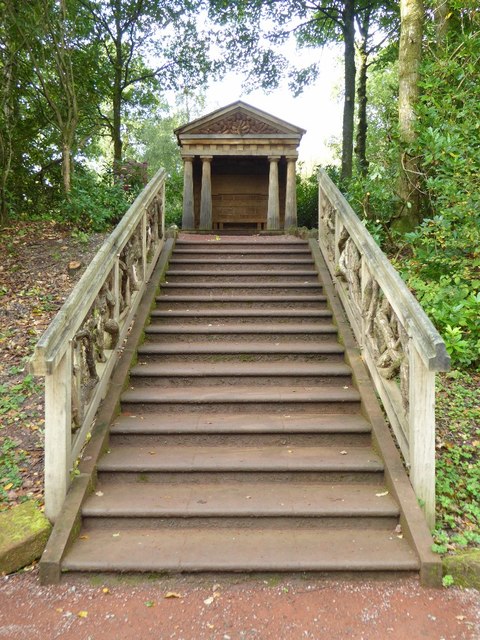
Ezekiel 40:48 Then he brought me to the portico of the house and measured the jambs of the portico; they were five cubits thick on each side. The width of the gate was fourteen cubits, and the side walls of the gate were three cubits wide on each side. Ezekiel 40:49 The portico was twenty cubits across and twelve cubits deep, and 10 steps led up to it. There were pillars by the jambs, one on each side.
Eichrodt suggests that one of the ways of interpreting this last section of Ezekiel is to see it as “a prophetic vision of a future which the divine Lord of the people will bring into effect in his own time in complete independence from man” (531).
I think that is partly a helpful approach, but I think it is also a challenge. It is a challenge to the Jews in Ezekiel’s time to work toward a society that matched the glory of the new temple envisioned. It is also a challenge for Gentile Christians — or Christians of all ethnic origins — to set our standards high because we are called to house the presence of God.
God is at work. May we provide him a willing platform to do his work — in us and through us.
Ezekiel 40:44 Outside the inner gate, within the inner court, there were chambers for the singers: one beside the north gate, facing south, and another beside the south gate, facing north. Ezekiel 40:45 Then the man said to me: “This chamber that faces south is for the priests who keep charge of the house. Ezekiel 40:46 The chamber that faces north is for the priests who keep charge of the altar. These are the sons of Zadok, the ones from the sons of Levi who may approach Yahveh to serve him.” Ezekiel 40:47 Next he measured the court. It was square, 100 cubits long and 100 cubits wide. The altar was in front of the house.
sons of Zadok
Zadok’s line became the line from whom the high priest would come, particularly because he remained loyal to David during the rebellion of Absalom.
I think it is also significant that in the temple Ezekiel sees, only sons of Zadok may approach Yahveh. In Hebrew, צָדוֹק means righteous.
Only the righteous may approach the LORD — only those to whom the righteousness of God is imputed through the finished work of Christ on the cross.
Ezekiel 40:38 There was a chamber whose door opened into the gate’s portico. The burnt offering was to be washed there. Ezekiel 40:39 Inside the gate’s portico there were two tables on each side, on which to slaughter the burnt offering, failure offering, and guilt offering. Ezekiel 40:40 Outside, as one approaches the entrance of the north gate, there were two tables on one side and two more tables on the other side of the gate’s portico. Ezekiel 40:41 So there were four tables inside the gate and four outside, eight tables in all on which the slaughtering was to be done. Ezekiel 40:42 There were also four tables of cut stone for the burnt offering, each a cubit and a half long, a cubit and a half wide, and a cubit high. The utensils used to slaughter the burnt offerings and other sacrifices were placed on them. Ezekiel 40:43 There were three-inch hooks fastened all around the inside of the room, and the flesh of the offering was to be laid on the tables.
all on the altar
If I am correct in assuming that Ezekiel’s temple vision predicts a new person, a new temple for the presence of God within — then the appearance of this section providing for the burnt offering speaks of the total commitment of the new person in the coming new age.
Jesus challenged his disciples to take up their crosses and follow him — to death if necessary. Most of them did die for their faith. Only someone convinced of a new life to come will sacrifice his all on the altar.
Ezekiel 40:35 Then he brought me to the north gate. When he measured it, it had the same measurements as the others, Ezekiel 40:36 as did its recesses, jambs, and portico. It also had windows all around. It was 50 cubits long and 25 cubits wide. Ezekiel 40:37 Its portico faced the outer court, and its jambs were decorated with palm trees on each side. Its stairway had eight steps.
No surprises here. I’m just reflecting again on the reality of the new temple. The fact that Ezekiel sees a new temple suggests hope for a revived future — one in which God is again present among his people, and worship resumes minus the corruption and shame that Ezekiel saw in his earlier visions of the present temple.
How about you? Do you sense that God is doing something in you, your family, your church? Are things going to improve? The Christian gospel calls on people in the worst conditions to rejoice, not because they have the power within them to change their circumstances, but because Christ chooses to bless them. The future is always brighter because God is going to intervene.
LORD, rebuild us — a fitting temple for your presence.







 Devotions